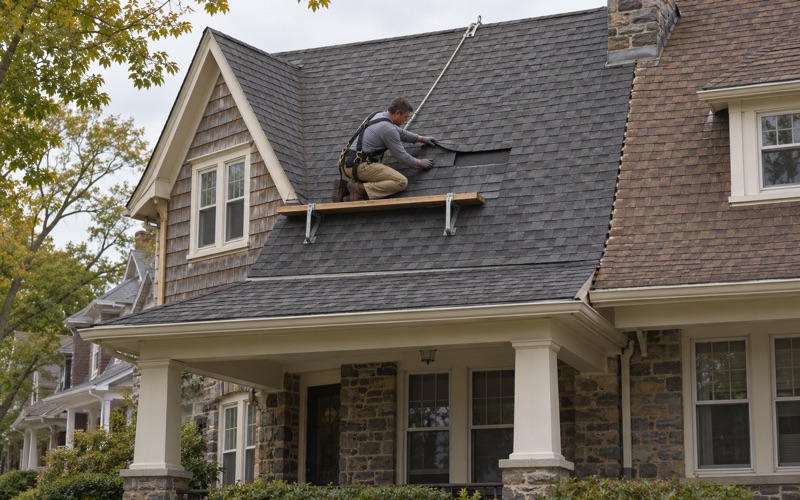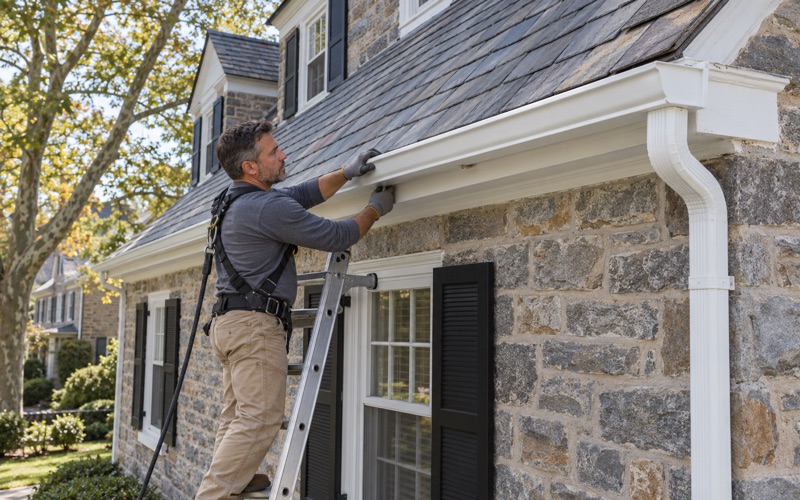
Lower Merion Elite Roofing brings more than 20 years of roofing in Concord Township and the surrounding Delaware County townships to a job that is often a homeowner’s first. A large share of the houses here are still on the roof they were built with or the one that replaced it, and the first time that roof comes off is a different job from the third.
That difference shapes how we price. Before anyone talks about a new roof, we tell you plainly whether the one you have can be repaired, and every leak call includes a trip into the attic as well as onto the shingles, so we find where water is actually getting in instead of guessing from the ceiling stain.
When replacement is the right answer, the estimate settles tear-off or overlay on the first page rather than the last. Our written scopes break out tear-off, decking, underlayment, flashing, ventilation and gutters as separate lines, which lets you set our number beside any other contractor’s and compare them item by item.
Concord’s 1990s and 2000s Build-Out
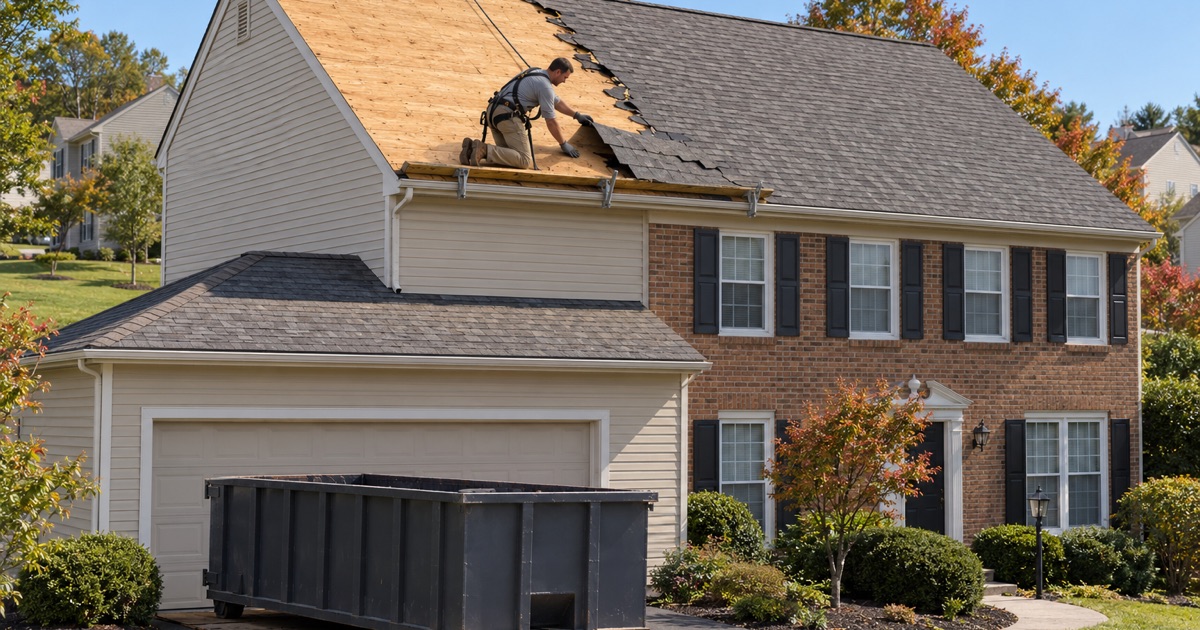
Concord Township grew late and fast. The census counted 9,933 residents at the 2000 count and 17,231 by 2010, and the housing record shows where those people went: into new subdivisions built across the two decades on either side of the turn of the century.
For a roofer, that history matters more than any landmark. It tells us roughly how old the roofs on a given street are likely to be, before we ever set a ladder against a house.
Nearly half the township from two decades
The American Community Survey five-year estimates for 2024 count 7,102 housing units in the township. Of those, 1,413 were built during the 1990s and 2,041 during the 2000s, a combined 3,454, or 48.6% of every home in Concord.
Set against that, 2,226 units predate 1990 and 1,122 were built from 2010 on. The middle band is the biggest single group of houses in the township, and it is the group now reaching the age where roofs come up for discussion.
Concord Crossing and Concord Woods
The period shows up in named neighborhoods. Concord Crossing is a townhouse subdivision on Century Lane in the Garnet Valley school district, with a unit at 3201 Century Lane recorded as built in 1999.
Concord Woods is a community of 101 homes on Huntingdon Farm Drive, Nicklin Lane and Big Woods Drive, entered at Cheyney Road and Huntingdon Farm Drive. Its own homeowners association publishes bylaws and covenants, which matters for the planning step we cover further down this page.
A Glen Mills address is not always Concord
Many Concord homes carry a Glen Mills or Garnet Valley mailing address, but those same addresses also cover parts of neighboring townships. A post office name does not tell you which township issues the roofing permit.
Each township in our service area sets its own re-roof rules, so we confirm the house’s actual municipality before we price the job. For one Andrien Road address, for example, a property record names Concord Township, and that is the rulebook we work from.
Looking for roofing closer to Upper Southampton? See Roofing in Upper Southampton.
A First Replacement on a 17- to 36-Year-Old Roof
A house finished between 1990 and 2009 carries a roof that is now roughly 17 to 36 years old. That is the span in which an original asphalt roof is usually replaced for the first time, so many of the Concord re-roofs we price are first replacements rather than repeat ones.
The age span is arithmetic on build years, not a promise about any one roof. Exposure, attic conditions and the quality of the original installation all move the date in one direction or the other.
Why the first replacement is its own kind of job
On a first replacement there is normally one layer of shingles to remove, not two or three. Nobody has opened the roof since the framers and roofers closed it, so the decking, the flashing at walls and chimneys, and the attic venting are being seen for the first time in decades.
That is useful information to have. It means the estimate can describe what the original crew did and where it held up, rather than layering assumptions about what a previous re-roofer may have changed or covered over.
What we do not assume about your roof
We have no record of which shingle any Concord builder installed, and age alone does not prove a roof is still the original one. Any given house may have been re-roofed early after storm damage, or sold with a newer roof already on.
So we confirm on site rather than date the roof from the deed. A look at the shingle profile, the edge layers and the attic side of the decking usually tells us whether this is a first replacement, and we say so in writing before the scope is set.
Repair still comes first
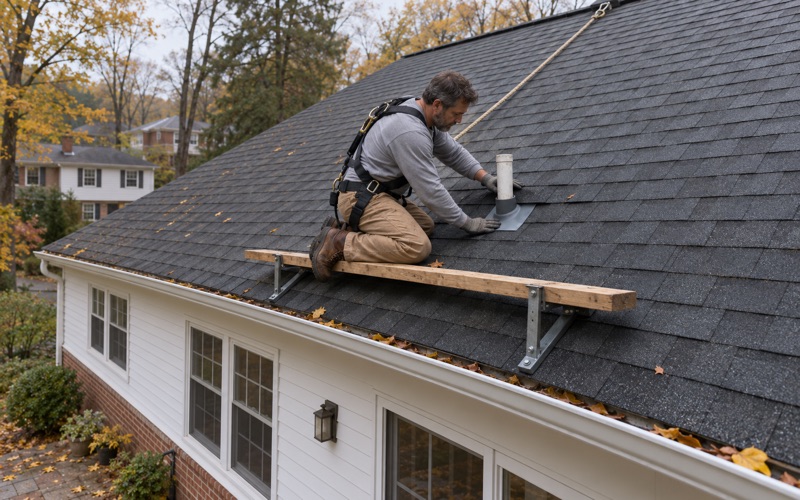
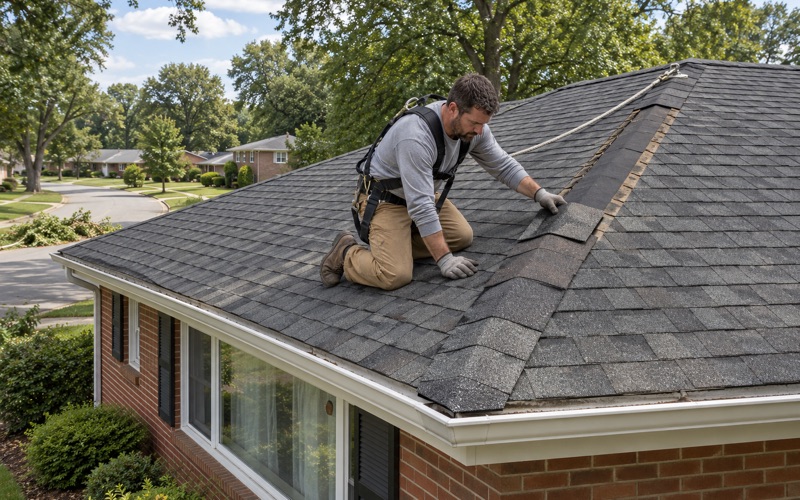
A roof in this age range is not automatically finished. A lifted tab, a cracked pipe boot or a worn vent collar can be repaired for years of service, and we would rather tell you that than sell a roof you do not need yet.
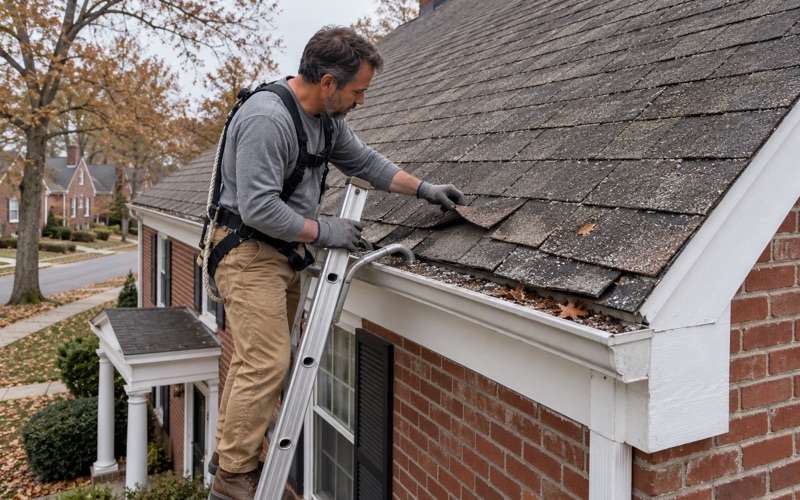
When the shingles themselves are worn through across the slopes, granules are washing into the gutters, and the leaks are coming from the field rather than one detail, replacement is the honest answer and we explain why.
Tear-Off or Overlay Under Concord’s Two-Layer Limit
Concord Township’s roof permit form limits coverings to two layers, including the new one. On a house that still has its first roof, that makes this replacement the only one on which laying new shingles over the old is still allowed.
When an overlay is permitted at all
The same form bars a new covering over wood shakes, slate, clay, cement or asbestos-cement tile, and over any covering that is water-soaked or deteriorated. Asphalt shingles are not on that list, so for an asphalt roof the material rule does not rule out an overlay by itself, but the condition rule often does.
If the existing shingles are curled, soft or holding water, an overlay is off the table regardless of the layer count. We check that before the estimate is written, not after the crew is on the roof.
Whichever path we take, the form also requires ice and water shield on all ‘A’ roofs with a minimum slope of 2:12, and two underlayment layers where the slope is less than 4:12. We build both into the scope on the lines where they belong.
Why we usually recommend the tear-off
An overlay saves the cost of removal now and spends your one remaining layer. The next roof will then have to be a full tear-off of two layers, heavier and slower to strip, and the decking will have gone another two decades without anyone seeing it.
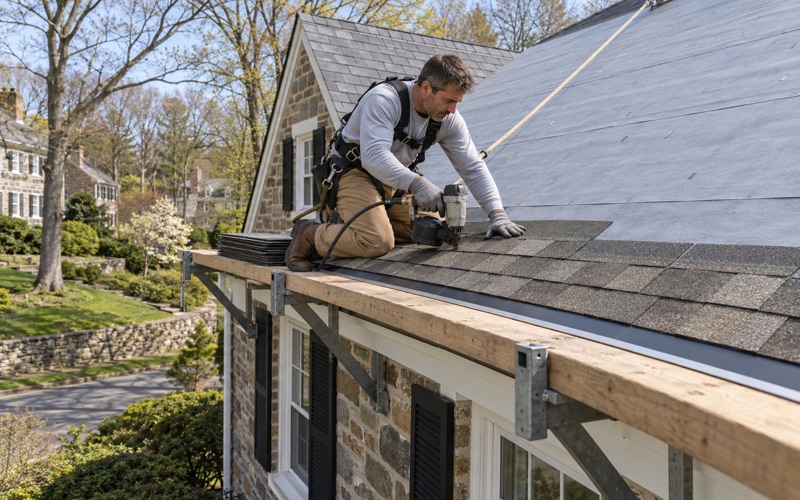
A tear-off lets us replace flashing instead of reusing it, inspect every sheet of decking and set new drip edge at the eaves and rakes. For most first replacements we think that trade is worth it, and we show the price of both options side by side so the choice is yours.
Deciding it at the start of the estimate
Because the two-layer rule turns the decision into a one-time option, we put it on the first line of the scope. We confirm the layer count by looking at the roof edge and, where needed, a lifted shingle, then write down which path we are pricing and why.
Concord also lists re-roofing among the work that needs a township permit through its Code Enforcement office, so the scope we hand you reflects that from the beginning. We file that permit ourselves and show its cost as a line in the estimate.
What a First Tear-Off Uncovers, and Who Decides
Removing the original layer is where a first replacement earns its keep. It is the first chance in decades to see the parts of the roof that shingles hide, and on a townhouse or association lot, the first time the question of who decides comes up.
Decking, drip edge and flashing
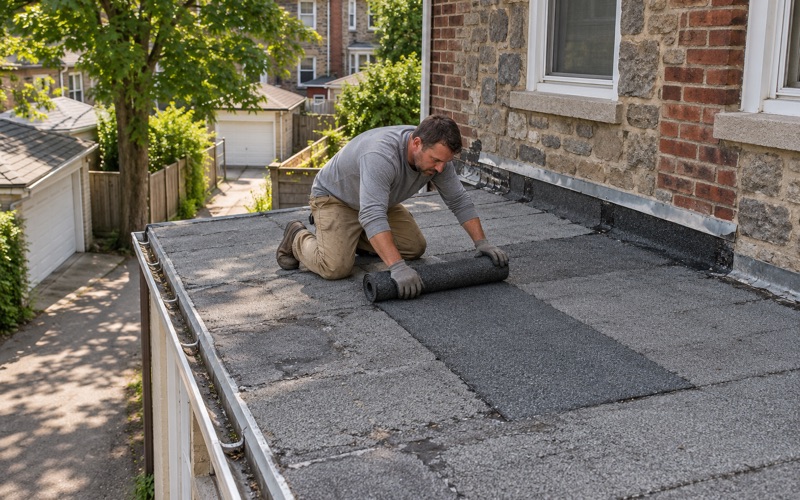
Original decking can be sound for a lifetime or soft at the eaves where ice and gutter overflow sat for years. If we find damaged sheets once the old roof is off, we photograph them, show you before anything is replaced, and charge the per-sheet price already written into the contract.
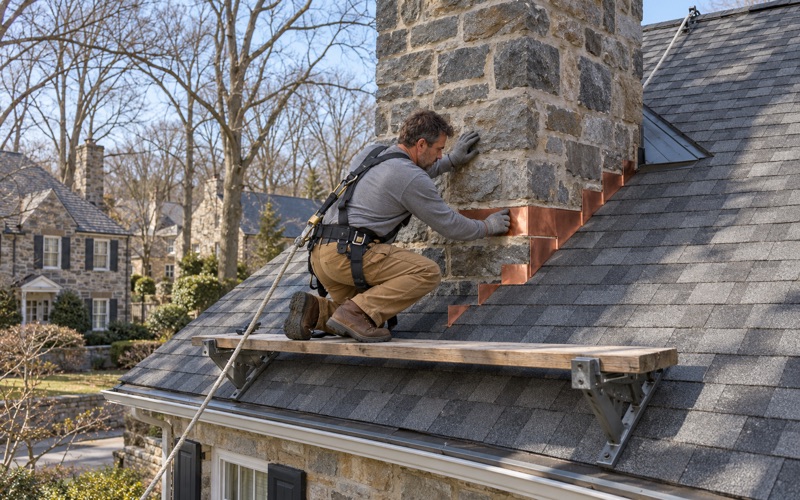
Step flashing along sidewalls and counter flashing at chimneys is replaced with the roof rather than bent back into service under new shingles. Continuous metal drip edge goes along the full roof perimeter, which the township form calls for on re-roofing work.
Attic ventilation seen for the first time
A first tear-off also exposes how the attic breathes. A house may have been built with a ridge vent or with box vents, and soffit intake is sometimes painted shut or blocked by insulation.
We check intake and exhaust together and size them so the attic moves air from soffit to ridge. A roof installed over a hot, damp attic ages faster than the shingle rating suggests, so we fix the venting with the roof rather than leave it for later.
Gutters and a clean site at the end of each day
Gutters on a house of this age may be original too, and a first replacement is the natural time to look at them. We size and pitch gutters and downspouts with the new roof so the drip edge, the eave and the gutter work as one system.
A tear-off sends old shingles and nails off every edge of the roof. At the end of every work day the crew cleans the driveway, yard and gutters, and runs a magnet sweep across the lawn for roofing nails.
Townhouses and association neighborhoods
On a townhouse in a subdivision like Concord Crossing, the roof runs continuously across shared walls. We plan the work with the neighbor’s roof and the party wall in mind, so the seam between units is flashed and closed properly rather than left as a patch at the property line.
In a neighborhood with its own homeowners association, such as Concord Woods, the association’s documents may say something about exterior changes. We have not read those covenants and do not guess at them, so we suggest checking with your association before the job is scheduled, and we will provide the shingle details you need to ask.
- 20+ Years Roofing
- Itemized Written Scopes
- Slate Repair Specialists