Lower Merion Elite Roofing brings more than 20 years of work to roofing in East Goshen, and on an older house here the first job is often a question rather than a quote. Before we price a tear-off, we want to know whether the house sits on the township’s historic list and what the township says about removing its roof. That answer shapes the schedule, the scope and sometimes the whole plan.
A leak call starts the same way on any house we visit. We look in the attic as well as on the roof, find where the water actually gets in, and tell the owner plainly whether a repair will hold before replacement ever comes up. On a farmhouse or an older home with sound material, that honest repair answer often matters more than anything else on the estimate.
When replacement is the right call, the written scope breaks out tear-off, decking, underlayment, flashing, ventilation and gutters as separate lines. That lets an owner set our estimate beside another one and compare them item by item. The contract follows Pennsylvania’s home improvement law, including the three-business-day cancellation notice and a deposit kept within the legal limit.
East Goshen’s Historic Resources Inventory and Goshenville
Class I and Class II on one township list
East Goshen keeps a Historic Resources Inventory, which the zoning code describes as a list and corresponding map showing the locations of all Class I and Class II historic resources in the township. Class I is the higher tier. It covers National Historic Landmarks, resources individually listed on the National Register, certified historic structures, contributing resources in a National Register historic district and resources with a determination of eligibility.
Class II covers resources of local significance. We have not read the inventory list or its map, so we never tell an owner whether a particular house appears on it. What we can explain is how the categories work, and that the township itself is the place to confirm a property’s status before any roofing work is scheduled.
Goshenville’s farmhouses and meetinghouse
The clearest Class I example sits in the Goshenville Historic District, mainly along North Chester Road at East Boot Road. The district was added to the National Register of Historic Places on November 8, 2000, with eleven contributing buildings, two contributing sites and two contributing structures from the 18th and 19th centuries. The district is one of three National Register entries Wikipedia lists for the township, alongside Goodwin Acres and the Ellis Williams House.
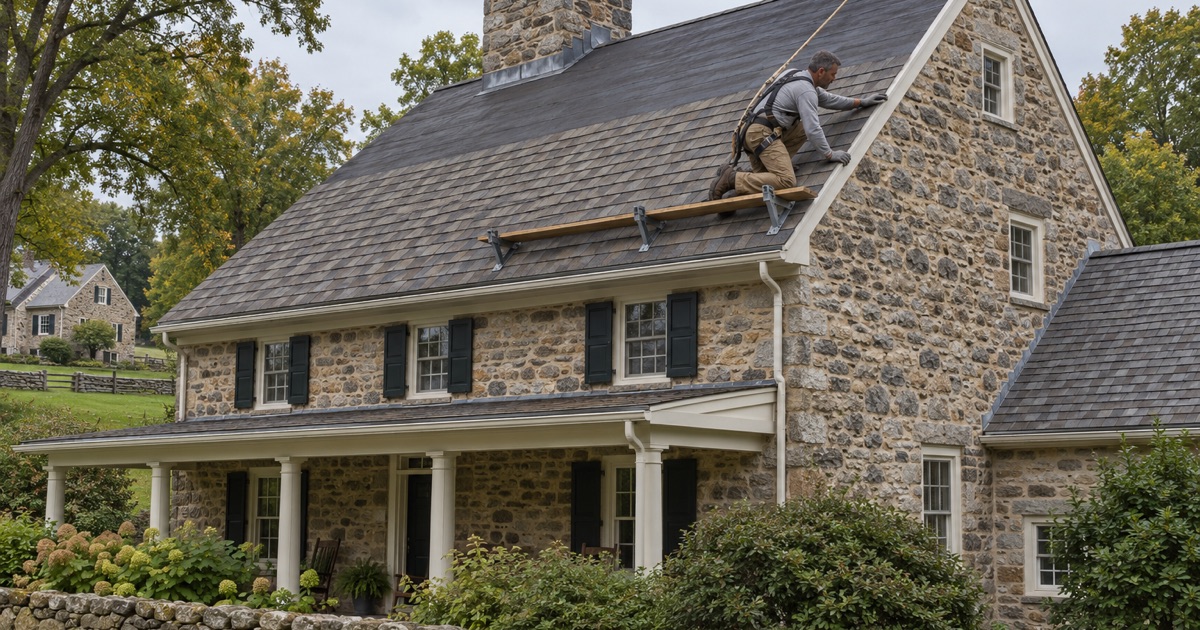
Those buildings include 1790s-era farmhouses, a tenant house dating to about 1750 and the Goshen Friends Meetinghouse, built in 1849. Because the zoning definition places contributing resources in a National Register district in Class I, the contributing buildings in Goshenville are inventoried historic resources by definition rather than by guesswork. We describe these buildings only as the public record does, without guessing at what covers their roofs today.
Older houses outside the district
Most of East Goshen’s housing is far newer. Census figures put 4,715 of the township’s 9,073 housing units in the 1970 to 1989 building years, and only 243 were built before 1940. An older roof outside Goshenville still deserves the same first question, because Class I also reaches individually listed properties and Class II reaches locally significant ones.
For those houses, we ask the township before quoting a tear-off, the same way we would on North Chester Road. The question takes little time to put in writing, and it keeps an estimate from resting on an assumption about a building’s status that nobody can confirm from the curb. Our scope then notes the answer, so the owner can see it was checked.
When a listing itself is in question
Inventory status is not fixed forever. Under Article VI, a proposal to change a property’s status on the inventory is referred to the Historical Commission, which sends a written report to the Board within 30 days of the close of testimony.
That process belongs to the owner and the township, not to a roofing contractor. We mention it only so an owner understands that the list has its own review procedure, and that a roof estimate is never the place to argue a building’s status. Our job is to work within whatever answer the township gives.
Looking for roofing closer to East Whiteland? See East Whiteland Roofing.
What East Goshen Counts as Demolition
Dismantling all or part of a resource
The township’s zoning chapter defines demolition as the dismantling or tearing down of all or part of any identified historic resource, along with all operations incidental to it. That is broad language. It does not say a building has to come down to the foundation before the word applies. A tear-off removes shingles, underlayment and sometimes sheathing, which is why the word deserves a careful read.
A separate definition covers demolition of a historic resource in its entirety or in substantial part, and it counts neglect as well as deliberate removal. The second definition carries the numbers that decide when a demolition permit is required. Those two definitions sit side by side, and an owner planning roof work on an inventoried house should know both exist before choosing a crew.
The 50 percent facade measure
Substantial part has a number attached. It means 50% or more of the gross area of all exterior facades, measured as the facades existed when the resource was placed on the Historic Resources Inventory. The demolition permit requirement in Article VI applies to demolition in whole or in substantial part.
The same section says additions or alterations involving less than 50% of the exterior facades do not need a demolition permit. That rule is written around facades, the walls a passerby sees. It measures wall area, which fits siding or an addition naturally and fits a roof far less obviously.
Where a roof falls in that language
Article VI, the township’s historic preservation article, does not mention roofs. A tear-off on an inventoried house could be read as dismantling part of the resource under the broad definition, or as an alteration well under the facade threshold. The code text we have read does not settle which reading the township applies.
So we do not tell an owner that a re-roof is exempt, and we do not tell them it counts as demolition. Either statement would be a guess. The honest position is that the question belongs to East Goshen, and we ask it before the job is priced.
The Historical Commission, the Board and Two Clocks
Who sees a demolition permit application
When a demolition permit is required for a historic resource, the Zoning Officer forwards the application to the Historical Commission and the Board of Supervisors. The Commission sends a written report within 15 days of its last meeting on the application, and the code provides no deemed approval. Both bodies see the same application, but only the Board issues the decision.
The Board weighs seven factors in reaching its decision, one of which is whether the resource has been intentionally neglected. That factor is a good reason not to let a failing roof on an old building sit for years while water works its way into the framing and plaster.
Sixty days to a hearing, 45 days to a decision
Once a complete application is filed, the Board has 60 days to hold a public hearing. After the hearing closes, it has 45 days to issue a decision. Put together, the two clocks can stretch a review across several months before any work begins.
For a roof, that timing matters. A replacement planned for late summer can slide into cold weather if the review turns out to apply, so we would rather learn the answer in spring than discover it after materials are ordered and a crew is booked.
The cost of skipping the question
The zoning code also covers what happens after an unlawful demolition: no building permit is issued afterward unless it restores the historic resource. That rule applies to demolition done without the required permit, which is exactly the outcome an early question avoids. Separately, the township’s fee resolution charges double the permit fee, with a $250.00 minimum, for residential work done without a permit.
Neither outcome is worth risking on a farmhouse or a listed building. Asking first costs a phone call. Guessing wrong can cost the project itself.
Asking the Township Before a Roof Tear-Off
Where we send the question
East Goshen’s Code Department handles building permits from the township building at 1580 Paoli Pike, West Chester, reachable at 610-692-7171. We put the specific question in writing: is this property on the Historic Resources Inventory, and does a full tear-off here count as demolition of part of the resource?
We keep the reply with the job file and share it with the owner. If the township says Historical Commission review applies, the schedule is built around that review rather than around our crew calendar. If the answer is that no demolition permit applies, the job moves ahead under the township’s ordinary permit rules and our normal schedule.
Repair first on an older house
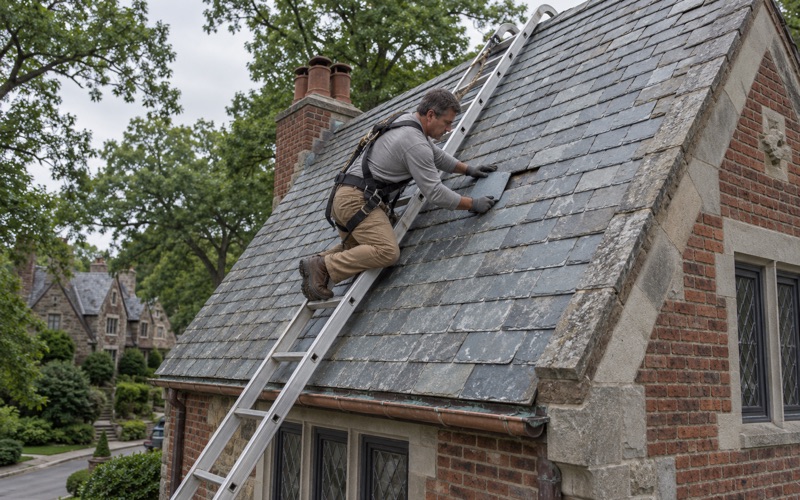
On an inventoried house, a repair that keeps sound material in place is a much smaller change to the building than a tear-off, and it is often the better choice anyway. Patching flashing, replacing a handful of broken units or resealing around a chimney can keep a historic roof working well. Where a sound slate roof needs attention, we repair it slate by slate with copper nails and slate hooks before anyone suggests removing it.
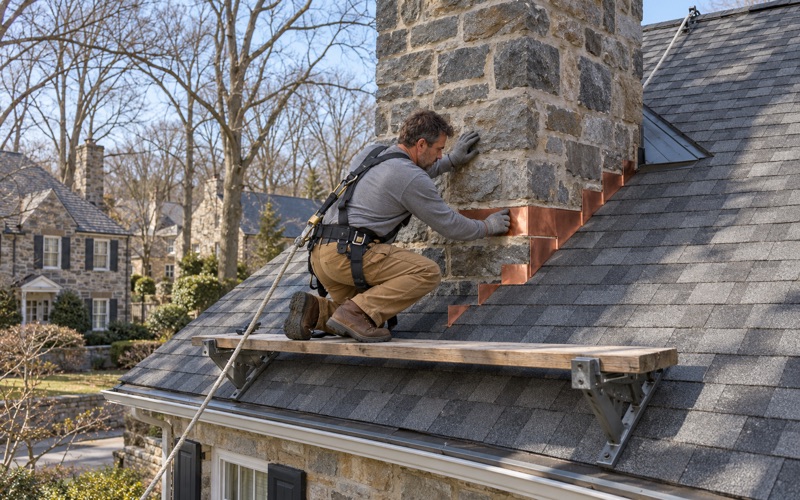
When replacement is truly needed, step, counter and chimney flashing are replaced with the roof rather than reused under new material. Rotted decking found once the old roof is off is photographed and shown to the owner before it is replaced, at a per-sheet price already written into the contract.
Permit, gutters and cleanup on every job
Each township in our service area sets its own re-roof permit rule, so we check East Goshen’s before pricing rather than assuming it matches Lower Merion. The township’s fee resolution prices residential re-roof and re-siding permits at 1% of cost with a $200.00 minimum, and that cost belongs on the estimate.
Gutters and downspouts are sized and pitched with the new roof, not added as an afterthought. At the end of every work day the driveway, yard and gutters are cleaned, and a magnet sweep picks up roofing nails before the crew leaves.
Weather windows and storm damage
East Goshen sits in National Weather Service forecast zone PAZ102, Eastern Chester, covered by the Mount Holly office. We check that zone forecast before opening a roof, and on an older house where a review has already pushed the schedule back, we would rather wait a few days for a clear stretch than leave old framing exposed overnight.
When a storm has already done the damage, we photograph it and write it up for the owner’s own insurance claim. If asked, our crew meets the adjuster on site, but the claim stays the owner’s to negotiate. On an inventoried house, the township question still comes before any tear-off the claim may pay for.
- 20+ Years Roofing
- Itemized Written Scopes
- Slate Repair Specialists