Lower Merion Elite Roofing handles roofing in East Whiteland for homeowners who need a clear read on what a storm actually did, and after more than 20 years of this work we start every damage call the same way: from the inside of the roof outward. A shingle that looks fine from the driveway can sit over a cracked rafter, and a stain on a bedroom ceiling can trace back to an opening several feet from where the water drips.
That habit matters most after the kind of night this township had in March. When a tree or a heavy limb lands on a house, the covering is the last thing we judge. We look at the framing, the sheathing and the hole itself before anyone talks about shingles, colors or brands.
We also give owners a straight answer on repair versus replacement before replacement comes up at all. Plenty of tree strikes end with a framed and decked patch blended into a roof that still has years left, and when that is the honest call, it is the one we write down.
The March 16, 2026 Storm and the Two Houses It Hit
A fast line across Chester County
On the night of March 16, 2026, a line of thunderstorms crossed Chester County from west to east in under half an hour. The Storm Prediction Center’s wind reports for that day log trees down at Glenmoore and Honey Brook first, then a tree down in a house in West Caln Township, then trees and wires down in North Coventry and West Vincent.
The line reached East Whiteland at about 10:36 that night, local time, and moments later the reports note several trees and wires down in East Malvern. Every one of those times is estimated from radar, and no wind speed was measured anywhere in the county. What the record shows is where trees came down, not how hard the wind blew.
Two reports of trees into houses
The two East Whiteland entries are short and specific. One reads “Tree fell into a house.” The other reads “Tree down into a house in East Whiteland Township,” and adds that there were multiple other reports of trees down. Both points geocode inside the township, in the Frazer and Malvern part of the Great Valley.
That is the whole public record: two tree-into-house reports and a note about other trees on the ground. It says nothing about what happened to either roof covering, and we will not pretend to know more than it says. What it does tell an East Whiteland owner is which kind of roof damage that storm produced here.
Why that kind of damage changes the inspection
Wind that lifts shingles leaves a roof with a covering problem. A tree that comes down onto a house leaves a structural problem first, because the load lands on framing that was never meant to carry a trunk. The order of the inspection follows from that difference.
If a large limb or a whole tree came down on your house that night, or on any night since, the shingles are a late question. The early questions are about the wood underneath them, and those answers decide whether the job is a patch or something larger. Solar panels near the strike add a step, because their removal and reinstall go into the schedule rather than being discovered on the day.
Looking for roofing closer to Bala Cynwyd? See Roofing in Bala Cynwyd.
When a Tree Comes Through the Roof: Rafters, Decking and the Opening
Rafters and trusses come first
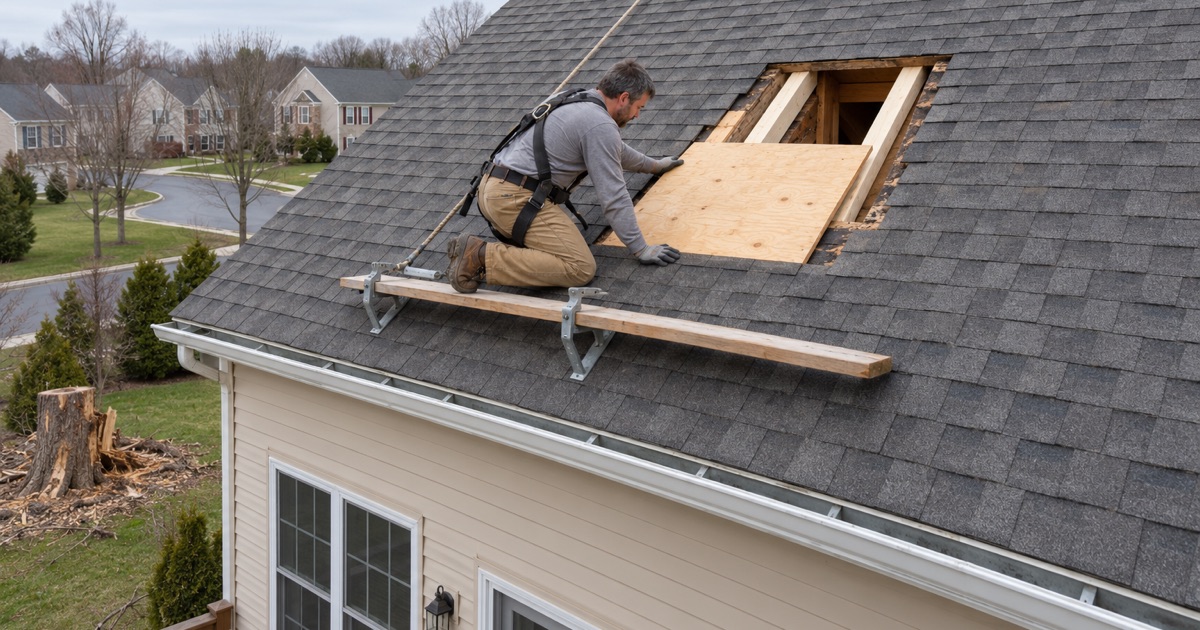
When a tree comes through a roof, we start in the attic, not on the ladder. Rafters and decking take the impact, and a cracked rafter or a split truss chord can hide under a covering that looks only dented from outside. We look for fresh splits, members pushed out of line, nails pulled from their seats and sagging along the ridge.
A damaged rafter is sistered or replaced before any sheathing goes back over it. Skipping that step leaves a new roof sitting on a frame that has already failed once, and the next heavy snow or wind load finds the weak spot. Where the damage reaches trusses, the repair approach is settled before anything is priced.
Decking around the strike
The sheathing nearest the impact is usually broken, but the panels around it can be cracked, delaminated or pulled loose from the framing without showing much from the street. We check the decking outward from the opening until it is sound, and we mark exactly where good wood begins.
Damaged decking is photographed and shown to the owner before it is replaced, at the per-sheet price set in the contract. Where the old decking is board sheathing rather than panels, the replacement is matched so the new roof lies flat across the patch. You see what came off and why, and the cost of extra sheets is never a surprise added after the fact.
Sizing the opening honestly
The hole a tree leaves is rarely the size of the repair. Underlayment tears beyond the break, shingles crack along the impact line, and flashing at a nearby wall or chimney can be bent out of shape. We trace the repair to the edges of what is actually damaged rather than to the edges of the visible hole.
Water also travels. A tree that opened the roof during a storm let rain into the attic, and insulation and ceiling drywall below the strike can hold moisture long after the surface dries. Every leak call includes a look in the attic so the water is followed to where it entered before a number goes on paper.
Temporary Cover and Photos for the Claim After a Tree Strike
Getting the opening covered
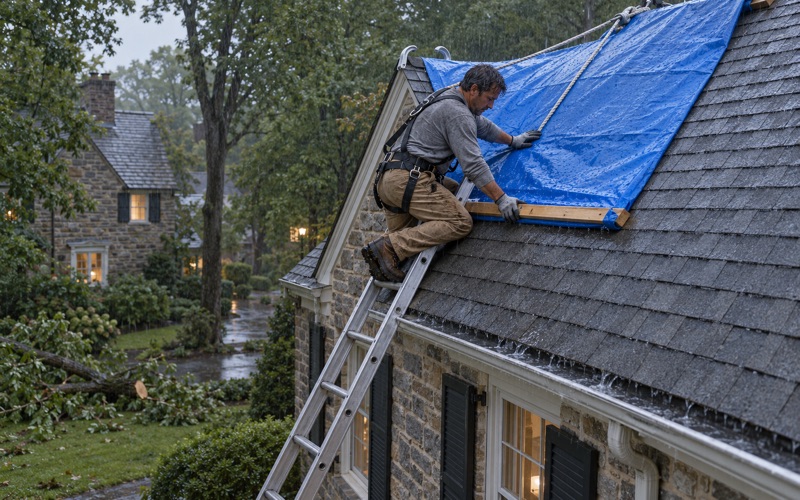
Once the tree is off the house, the first job is keeping more water out. A tarp over a punctured roof needs to extend well past the opening and be secured to sound framing, not just weighted at the corners, or the next gust turns it into a sail. Tree removal itself is a separate trade, and we work after the tree service has cleared the load.
A temporary cover is just that. If the tree broke through the decking, we cover the opening with sheathing fastened to the framing before the tarp goes over it, so the tarp is not the only thing holding back rain. It buys time for the framing and decking work, and it should not stay up long enough to trap moisture against the sheathing beneath it.
Documenting before anything is removed
We photograph the damage and write it up for the owner’s own claim, starting with the strike itself and working through the attic, the framing and the decking. Photos taken before debris is cleared and before temporary repairs go on are the ones that show what happened.
When an owner asks, a crew member will meet the insurance adjuster on site and walk the damage with them. We do not negotiate the claim. That conversation belongs to the owner and the insurer, and Pennsylvania’s insurance rules set timelines for acknowledging and deciding a claim, not a promise of what the policy pays.
Comparing estimates line by line
Our written scopes list tear-off, decking, underlayment, flashing, ventilation and gutters as separate lines. After a tree strike that matters even more than usual, because a second estimate or an adjuster’s figure can be checked item by item rather than as one lump total.
Contracts follow Pennsylvania’s home improvement law, with the three-business-day cancellation notice and a deposit kept within the legal limit. A storm-damaged house is exactly where an owner should have time to read a contract before signing it.
Checking an East Whiteland Roof After a Night Storm
What to look at the next morning
A storm that arrives after dark leaves owners guessing until daylight. In the morning, look for limbs resting on the roof, broken branches in gutters, dents along the eaves and any line of shingles that no longer sits flat. Inside, check upstairs ceilings and the attic for wet insulation or daylight where there should be none.
East Whiteland sits in National Weather Service forecast zone PAZ102, Eastern Chester, served by the Mount Holly office. Watching that zone’s warnings on a stormy evening tells you when to expect a line like the one in March, and checking the attic with a flashlight soon after it passes catches a slow drip before it reaches the ceiling.
If a limb is still on the roof, leave it for a tree service. Pulling it off from a ladder can tear more of the covering and puts the person on the ladder at real risk.
Permits and the township’s rules
Every municipality sets its own re-roof rules, so we check East Whiteland’s before a job is priced. The East Whiteland Township Codes Department runs an online permit portal, and the township’s 2026 fee schedule prices a residential re-roof for one- and two-family dwellings at 2% of cost with a $50.00 minimum, plus the state education fee.
The township adopted new International codes as of February 11, 2026. Residential home improvement contractors working here provide their Pennsylvania Home Improvement Contractor number along with a certificate of insurance naming East Whiteland Township as the certificate holder, and we take care of that paperwork before work is scheduled.
Housing that ages differently
Much of East Whiteland’s housing is recent: 1,799 of the township’s 5,737 housing units were built in 2010 or later, according to the latest five-year Census estimates. Another 1,049 units are single-family attached homes, and a tree that lands on one of those roofs is planned around the neighbor’s roof and the shared wall. A newer roof that took a tree strike is often a good candidate for a framed repair rather than a full replacement.
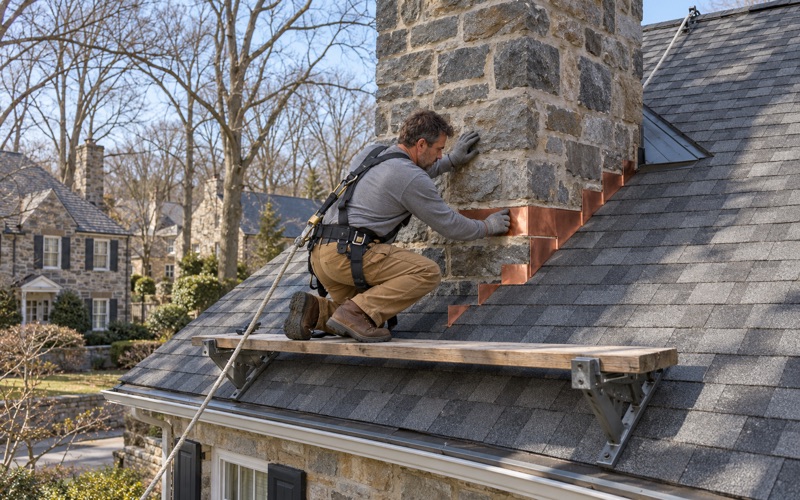
Older homes in Frazer and Malvern call for a different inspection. Their framing may be older dimensional lumber, and step, counter and chimney flashing near the strike is replaced with the repair rather than reused. Either way, the gutters are checked and re-pitched with the roof, and the driveway and yard get a magnet sweep for nails at the end of each work day.
- 20+ Years Roofing
- Itemized Written Scopes
- Slate Repair Specialists