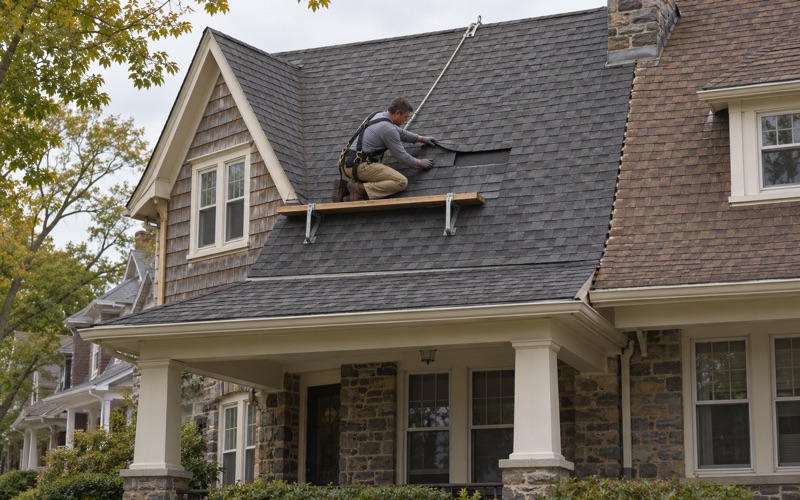
Lower Merion Elite Roofing has handled roofing in Overbrook and the neighborhoods along the city line for more than 20 years, and on this side of the line the work answers to the City of Philadelphia. Before we talk about shingles, flashing or price, we work out which rules govern your particular house, because in parts of Overbrook that question shapes the schedule as much as the weather does.
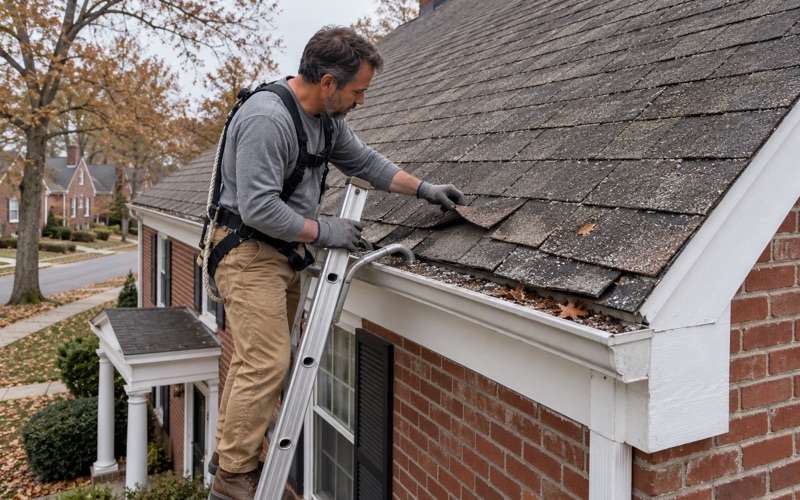
Every leak call starts with two inspections, one on the roof and one in the attic, so we follow the water to the place it actually enters before anything gets priced. You also hear a plain answer about whether the roof can be repaired before anyone mentions a replacement. Plenty of older roofs need a section of flashing or a handful of slates repaired, not a full tear-off.
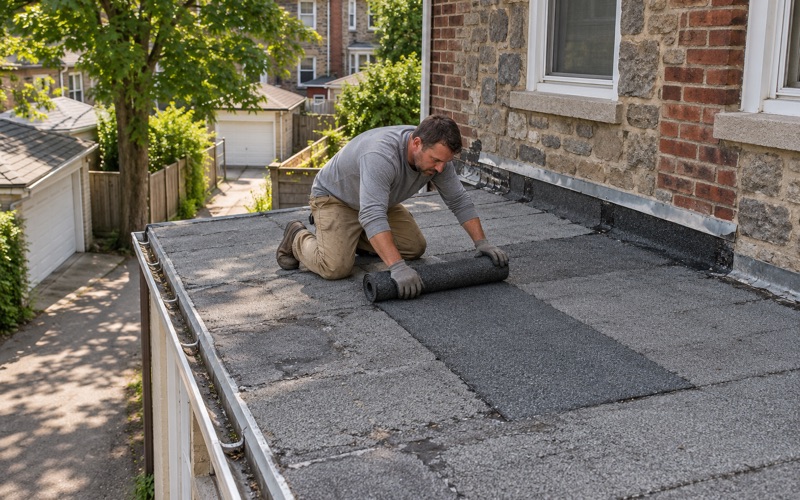
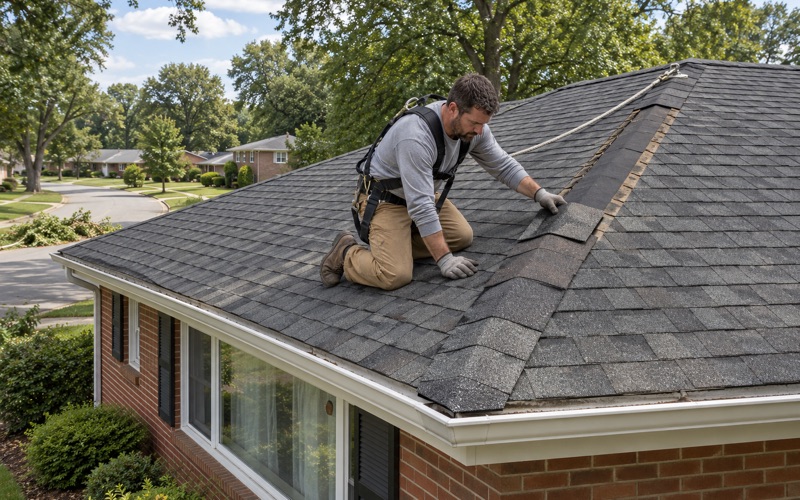
When replacement is the honest answer, our written scope breaks tear-off, decking, underlayment, flashing, ventilation and gutters into separate lines, so you can lay it beside another estimate and compare item by item. For a Philadelphia address the permit path is part of that scope from the start, and for houses inside the Overbrook Farms Historic District that path runs through the Philadelphia Historical Commission first.
Overbrook Farms, a Philadelphia Historic District Since 2019
Overbrook is a historic neighborhood in the northwest of West Philadelphia, and Overbrook Farms is one section of it rather than the whole neighborhood. That distinction matters to any homeowner planning roof work. Whether your house sits inside the district or a few blocks outside it changes who has to sign off before a roofer can pull a permit.
Where the District Boundaries Run
The Commission’s Committee on Historic Designation set out the boundaries in October 2019. The district is bounded by City Avenue on the north, North 58th Street on the east, the property line of the houses facing onto Woodbine Avenue on the south, and North 66th Street on the west. City Avenue is also the line between Philadelphia and Montgomery County, so a house on the Overbrook side follows city rules only.
The Philadelphia Historical Commission voted unanimously on November 8, 2019 to designate the district, ending an effort of nearly 15 years. From that vote on, exterior alterations within the boundaries need Commission approval. If you are unsure whether your lot falls inside, we check the address against the district map before we schedule anything.
What the District Holds
The district covers 501 properties, approximately 90% of them residential. The committee classified 13 as significant, 430 as contributing and 58 as non-contributing, with two more already individually listed on the Philadelphia Register. The development was financed by the Drexel Syndicate and envisioned by developers Herman Wendell and Walter Bassett Smith.
Most of the houses are Colonial Revival or Tudor Revival, built roughly between 1893 and 1929, with more than 20 styles represented in all, including Queen Anne, Dutch Colonial Revival, Shingle and Prairie. The committee noted that most still keep their original form and materials, likely owing to the predominance of masonry construction. A roof on one of these houses sits on a building the city has decided is worth keeping as it is.
Why the Style of the House Matters to the Roof
A Colonial Revival roof and a Tudor Revival roof read differently from the street. Tudor Revival houses typically carry steep, prominent slopes and cross gables, while Colonial Revival houses lean toward simpler, symmetrical forms. Either way, the roof is a large part of what passersby see, which is exactly why the Commission treats it as part of the building’s appearance.
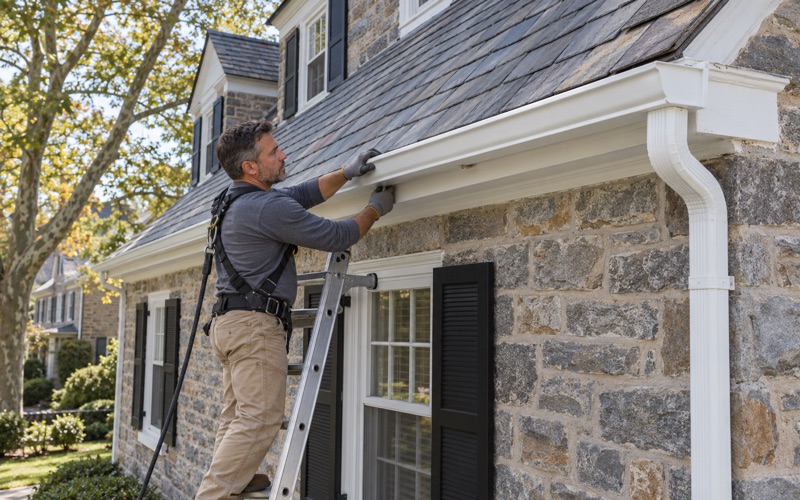
We do not assume what your roof is made of before we see it. The first visit records the existing material, its condition, the flashing at chimneys and walls, and how visible each slope is from the street. Each of those details shapes the application that follows.
Looking for roofing closer to Westtown? See Roofing Services in Westtown.
Why a Re-Roof Counts as an Alteration in Philadelphia
Many homeowners assume that replacing a roof with something similar is routine upkeep. In Philadelphia the rules say otherwise, and knowing that before the old roof comes off saves weeks of delay and the risk of a stop-work order.
What the Commission’s Rules Say
The Commission’s Rules and Regulations, in the revision dated 3-12-2021, define alteration in Section 2.1 and state plainly that “Alteration includes the reroofing, cleaning or pointing of a building.” The definition cites Section 14-203(15) of the Philadelphia Code. A new roof on a district property is therefore an alteration the Commission reviews, not a private maintenance choice.
That does not mean every small fix needs an application. Section 13.3 says the preservation ordinance does not prevent ordinary maintenance or repair where the work does not require a permit by law and restores the building to its condition before deterioration. Section 13.2 also requires the exterior of every building in a historic district to be kept in good repair, so putting off a failing roof is not a safe way around review.
Why L&I Will Not Issue the Permit First
Building permits come from the Philadelphia Department of Licenses and Inspections, known as L&I, under the Philadelphia Building Construction and Occupancy Code. The city’s building permit page puts the sequence bluntly: “L&I will refuse your permit application without Historical Commission approval.” For a house inside Overbrook Farms, the Commission’s sign-off comes first and the permit follows.
Work done without a permit or Commission approval draws a staff request for an L&I violation and stop-work order under Section 13.1. A 2025 Commission case shows how that can play out. A slate mansard on a property recently placed in a historic district was replaced with asphalt shingles before owners had written notice, so the Commission never reviewed it, and L&I issued a violation that led to a legalization request.
The EZ Re-Roofing Permit and Historic Listing
Philadelphia offers an EZ re-roofing permit for straightforward jobs, and we use it for city addresses where it applies. L&I’s EZ Permit Standard for re-roofing, PB_012_F, states that the EZ process “shall not be applicable to buildings listed as historic as established by the Philadelphia Historical Commission without prior approval.” The same standard tells owners to contact staff at preservation@phila.gov in the planning stages of the project.
For a house in the district, the quick route is not available on its own. We build the Commission step into the schedule rather than discovering it after the materials are ordered.
What Commission Staff Can Approve, and When Review Goes Further
Not every roof application goes before the full Commission. The rules give staff authority to approve certain roofing work on its own, and knowing which category a job falls into is how a realistic schedule gets written.
Staff Approval and the Five-Day Window
Under Section 6.10 of the rules, staff “is not authorized to deny any application, but only to approve some applications and refer all others.” Staff completes the reviews it keeps within five working days of a complete application. A referral is not a denial; it means the application moves on to the Architectural Committee and the Commission.
The Commission’s permit logs record staff-level approvals for repair or replacement of roof coverings on existing roofs in accordance with the EZ Permit Re-Roofing Standard. A complete application, with clear photos and a plain material description, is what keeps a qualifying job on that staff-level path.
Replacing Deteriorated Slate
Staff may approve the replacement of slate roofing materials when the severity of deterioration requires replacement and the substitute materials closely approximate the color and shape of the historic slate. Both conditions have to be met. A substitute that looks wrong from the street, or a slate roof that could reasonably be repaired, falls outside that approval.
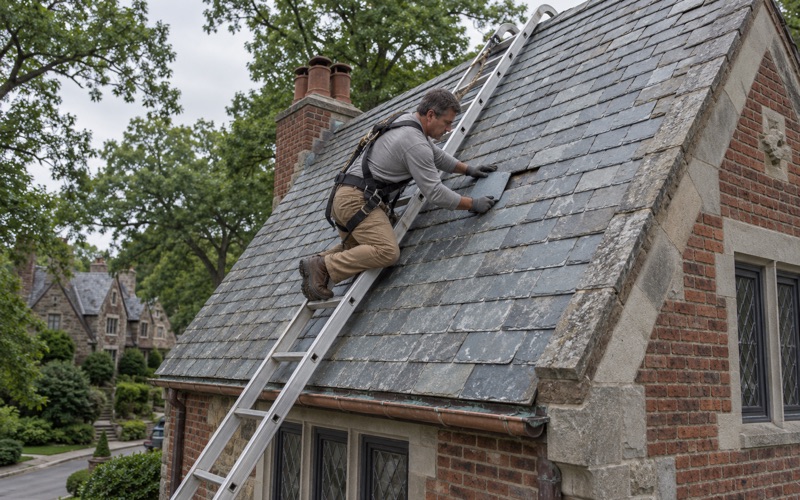
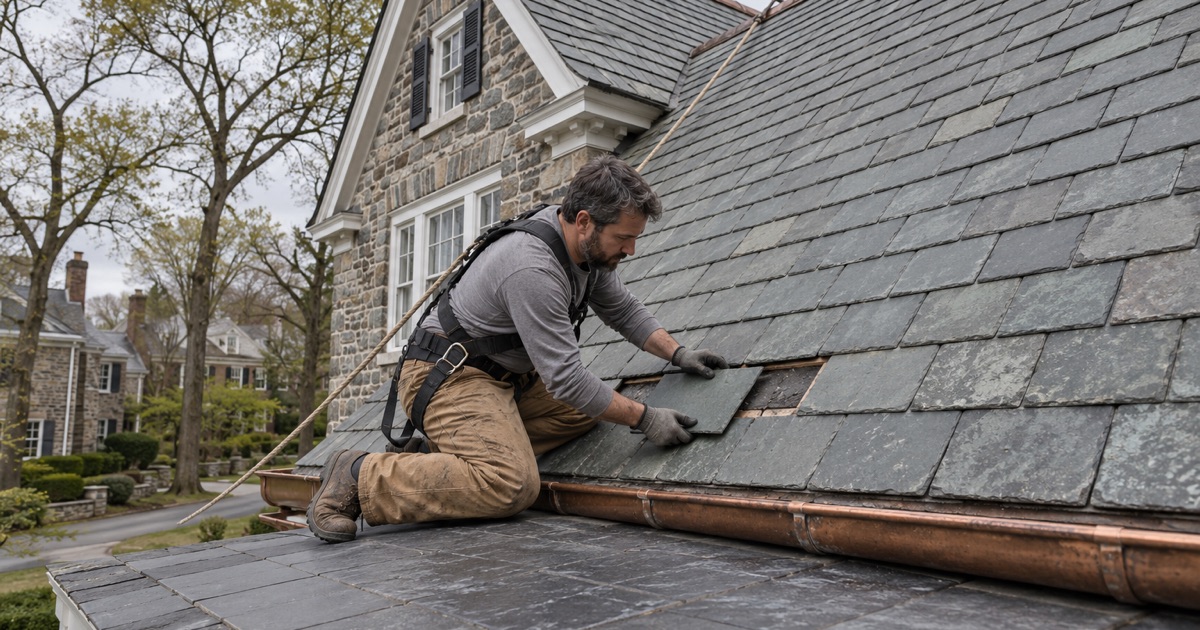
Where a house has slate, we start with repair. Our crews work slate by slate with copper nails and slate hooks before anyone recommends tearing off a sound slate roof, an approach that keeps historic material in place. When replacement is genuinely needed, we document the deterioration and the proposed substitute so staff can judge the match.
Mansards, Turrets and Character-Defining Features
The staff approval for slate carries an explicit exception for mansards, turrets and other character-defining features. A mansard slope or a turret roof is not something staff signs off on alone under that provision, so that work is referred for further review. Owners should expect more time on the calendar for those roofs.
The same section lets staff approve alterations to secondary elevations that are not visible, or have limited visibility, from public rights-of-way. A rear slope hidden from the street may move faster than a front gable, which is why we photograph each slope from the sidewalk during the first visit.
When the Original Roofing Is Gone
Some district houses no longer carry their original roofing at all. Staff may approve replacement roofing in that case when the proposed material is based on sufficient evidence and closely approximates or replicates the historic roofing. Old photographs or remnants of earlier roofing found during the inspection are the kind of evidence that supports such an application.
Staff reviews are guided by the Secretary of the Interior’s Standards. We describe the proposed material plainly in the application, with its color, shape and profile, rather than leaving staff to guess what will go on the house.
Planning a Roof Job in Overbrook from Estimate to Permit
Once the review path is clear, the rest of the job follows the same disciplined steps we use on every house. In Overbrook those steps are simply ordered around the Commission and L&I.
An Estimate Built Around the Approval Path
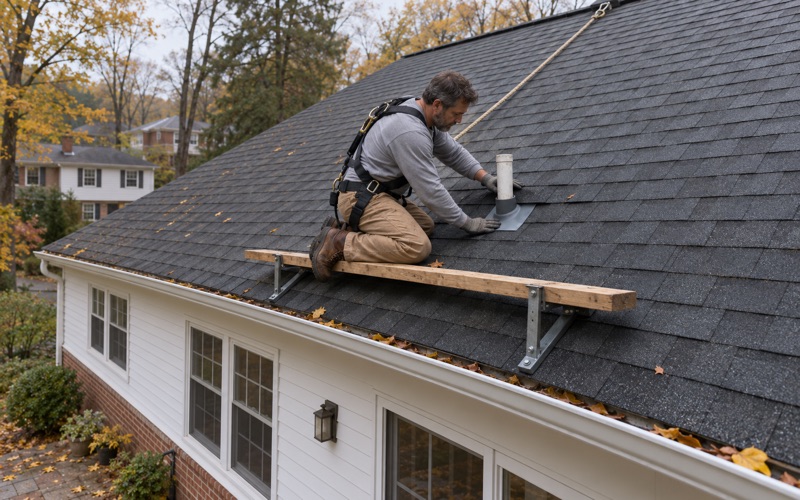
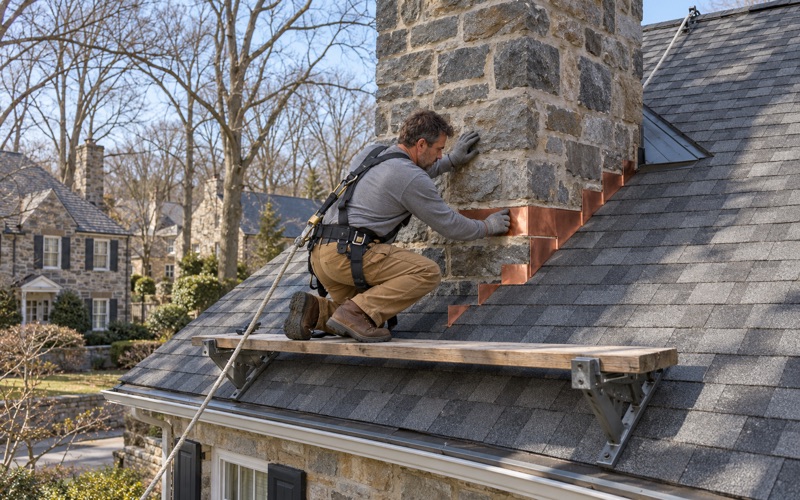
Our estimate names the review the house needs, whether that is staff approval, a referral, or the ordinary permit path for a house outside the district. Because the scope lists each part of the job on its own line, it doubles as the material description staff need to see. Step, counter and chimney flashing is replaced with the new roof rather than reused under it.
Contracts follow Pennsylvania’s home improvement law, including the three-business-day cancellation notice and deposits kept within the legal limit. If the Commission’s review changes the material, the scope is revised in writing before work begins.
Decking, Gutters and Shared Walls
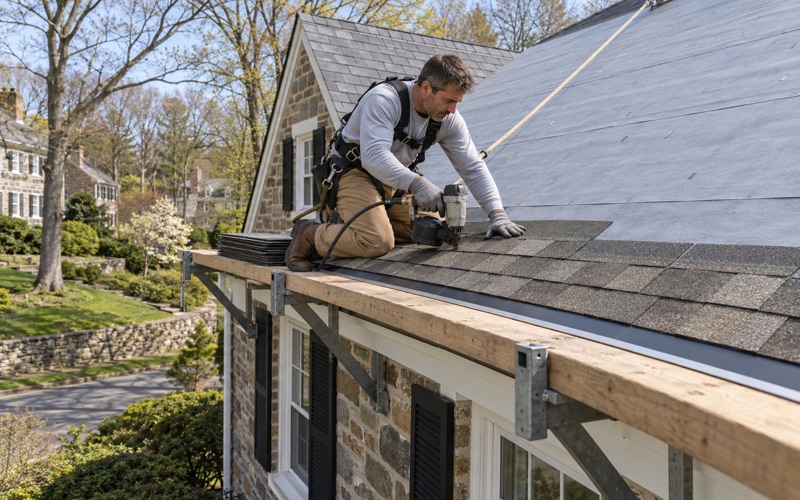
Once the old roofing is off, any damaged decking is photographed and shown to you before it is replaced, at a per-sheet price already set in the contract. Gutters and downspouts are sized and pitched together with the roof rather than added at the end. Where a house shares a wall or roofline with a neighbor, we plan the tie-in with that roof and the shared wall in mind.
Storm Damage and Daily Cleanup
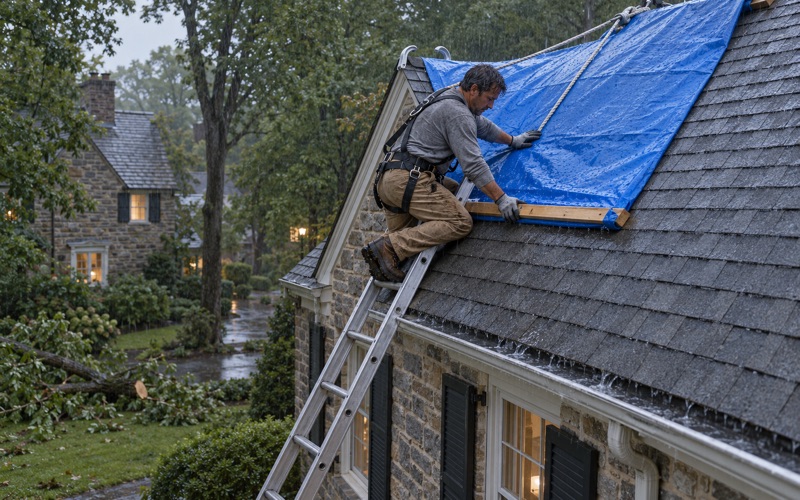
After a storm, we photograph the damage and write it up for your own insurance claim, and we will meet the adjuster on site when asked without negotiating the claim for you. Temporary protection can keep water out while a review runs, but a full replacement on a district house still goes through the Commission. At the end of every work day, the driveway, yard and gutters are cleaned, including a magnet sweep for roofing nails.
- 20+ Years Roofing
- Itemized Written Scopes
- Slate Repair Specialists