Lower Merion Elite Roofing has handled roof repair in Lower Merion, PA for more than 20 years, serving surrounding cities including Plymouth Township, Milford Township, Yeadon, Richland Township and West Norriton. We repair asphalt shingle, slate, metal and flat roofs, and the flashing, boots and gutters that most leaks actually come from.
A repair call with us starts with an honest diagnosis. We go into the attic as well as onto the roof, so the leak is traced to where water really enters rather than to where a stain happens to show on the ceiling. Then you get a straight answer about whether the roof can be repaired, before replacement is ever mentioned.
The repair price is written down before the work begins, with each item listed separately, so you know exactly what you are paying for. If we open a section and find soft decking underneath, we photograph it and show you before we replace a single sheet.
Repairs to Asphalt Shingle Roofs
Replacing Wind-Damaged and Missing Shingles
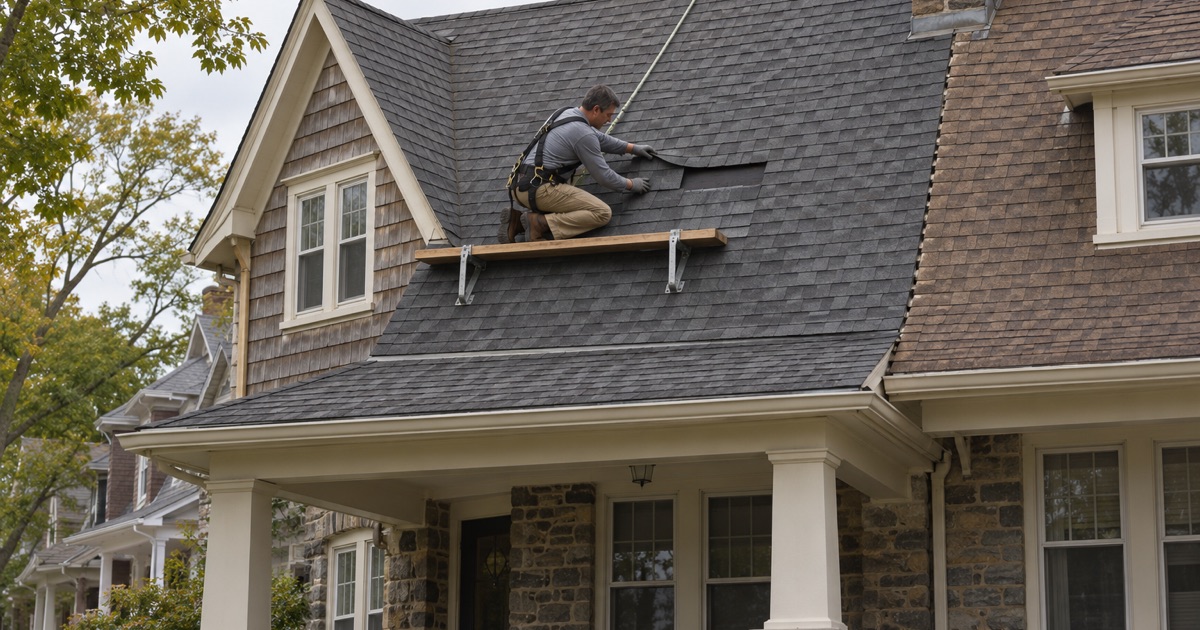
When shingles blow off, the cause is usually a sealant strip that never bonded or nails driven above the manufacturer’s nailing line. We remove the damaged pieces, slide in matching shingles, and nail them at the correct line with the right number of fasteners for that product. Then we hand-seal the surrounding tabs and check the rest of the slope, because shingles near a blow-off are often creased and next in line to fail.
Fixing Nail Pops and Exposed Fasteners
A nail that backs out of the decking lifts the shingle above it and leaves a hole for water to follow down the nail shank. It is one of the most common sources of small, hard-to-find leaks. We pull the popped nail, drive a new fastener beside it into solid decking, seal the old hole, and replace the shingle if it has been torn by the nail head.
Repairing Valleys and Granule Loss
Valleys carry more water than any other part of the roof, so they wear first. When the shingles in a valley are cracked or worn to the mat, we cut out the damaged section, lay new ice and water barrier down the valley, and reinstall the shingles in an open or closed valley to match the rest of the roof. Heavy granule loss across every slope, on the other hand, is a sign of a roof at the end of its life, and we will tell you so.
Flashing, Boot and Penetration Repairs
Chimney Step Flashing and Counter Flashing
Most chimney leaks come from failed flashing, not from the chimney itself. A proper chimney flashing has step flashing woven into each course of shingles and counter flashing set into a reglet cut into the mortar so water cannot get behind it. We remove caulked or tarred patches, install new step and counter flashing, and add a cricket behind a wide chimney so water does not pool against the masonry.
Pipe Boots, Vents and Exhaust Fans
Rubber pipe boots crack in the sun after some years, and the leak shows up as a small stain directly below the vent stack. We replace them with new boots or lead flashing boots, which last much longer, and reseal exhaust fans, attic vents and other penetrations with the flashing they were designed to use rather than a bead of sealant.
Skylights, Walls and Kick-Out Flashing
Where a roof meets a wall, water has to be sent back onto the shingles. A missing kick-out flashing at the bottom of a sidewall sends water straight into the siding or stucco, often rotting the wall long before a ceiling stain appears. We install kick-out and apron flashing where they are missing, reflash skylights with their own kits, and replace any rotted sheathing we find along the way.
Slate, Metal and Flat Roof Repairs
Slate Roof Repair One Slate at a Time
On older Main Line houses, a slate roof with a few cracked or slipped pieces almost never needs to come off. We replace each broken slate individually, fastening it with copper nails or a slate hook so the slate above stays undisturbed. Copper valleys and flashing are repaired with copper, because mixing metals causes corrosion where they meet.
Standing Seam and Metal Roof Repairs
Metal roofs usually leak at seams, fasteners and flashings rather than through the panels themselves. We reseal or replace failed fasteners, refasten loose clips, repair damaged seams and reflash penetrations so the panels can still expand and contract with temperature changes.
Flat Roof Patches on Additions and Porches
The low-slope roof over a rear addition, porch or garage is often where a house leaks first, because water sits there instead of running off. We repair blisters and splits in modified bitumen, reseal seams on EPDM and TPO, and reflash the wall where the addition meets the house. If a flat roof is ponding badly, we explain what it would take to correct the slope.
Repairs Particular to Older and Attached Houses
Box Gutter and Cornice Repairs
Many prewar houses drain their roofs through box gutters built into the cornice rather than gutters hung on the fascia. When the metal or membrane lining cracks, water goes straight into the cornice framing and the top of the wall, and the first sign is often peeling paint or a stained soffit rather than a ceiling leak. We open the gutter, cut out rotted wood, rebuild the framing and reline the trough with soldered metal or a membrane, then check that the outlet and downspout drain freely.
Party-Wall Repairs on Twins and Rowhouses
On a twin or rowhouse, the leak you see may start on your neighbor’s side of the roof, or a repair on your side may send water toward theirs. We look at both sides of the party wall before we start and detail the seam so each roof sheds water on its own. If the cause is on the neighbor’s roof, we tell you so in writing instead of patching your side and leaving the source in place.
Lead-Safe Work on Painted Trim
On houses built before 1978, the painted fascia, soffits and trim around a roof repair may contain lead paint. When a repair disturbs that paint, the EPA’s Renovation, Repair and Painting rule requires lead-safe work practices, including containment and cleanup. We plan for it whenever a repair reaches into painted wood, so the dust stays out of your yard and your house.
Temporary Repairs That Hold Until the Permanent Fix
Some repairs cannot be finished on the first visit, because a matching slate, a custom copper flashing or a dry day is needed. In those cases we install a temporary repair, such as a tarp, a sheet-metal patch or a membrane strip, that will stay watertight until we return. We tell you what the temporary fix is and when we are coming back, so nothing is left to chance.
How We Decide Between Repair and Replacement
Signs a Repair Is the Right Call
If a roof’s failures are isolated, such as one bad valley, a cracked boot, a damaged section from a single storm or a chimney with tired flashing, it is almost always a repair job. The rest of the roof still sheds water, so fixing the one weak point is money well spent.
Signs the Roof Needs Replacing
When shingles are curling across every slope, granules are piling up in the gutters, decking feels soft underfoot and leaks keep appearing in different places, patching is just delaying the inevitable. We show you photographs of what we found so you can judge it yourself, then give you the repair price first and explain what a replacement would get you.
Permit Rules When a Repair Grows
Pennsylvania’s Uniform Construction Code exempts ordinary repairs, but a repair that turns into re-roofing a whole section can trigger a permit. In Lower Merion that means the township’s roofing addendum, which limits shingle roofs to two layers. We tell you before we begin whether your job is a repair or a re-roof under the rules, so there are no surprises halfway through.
- 20+ Years Roofing
- Itemized Written Scopes
- Slate Repair Specialists