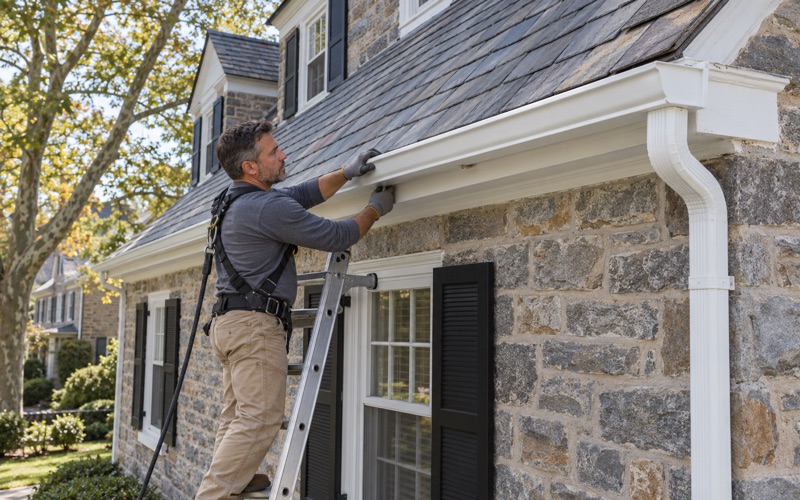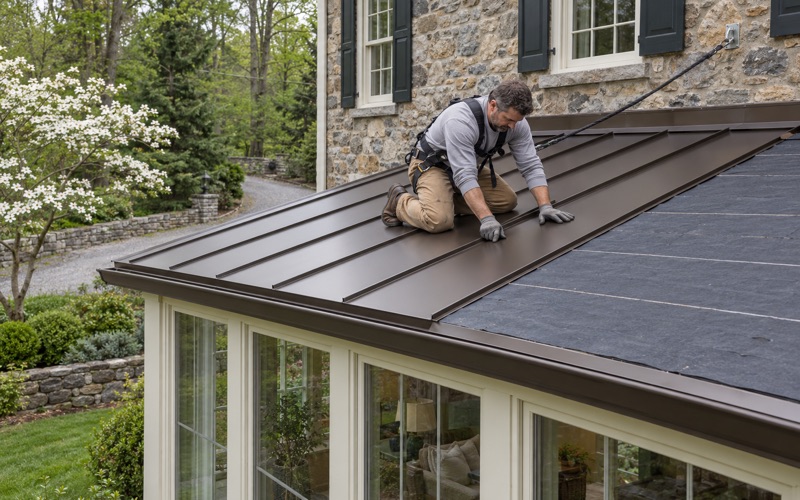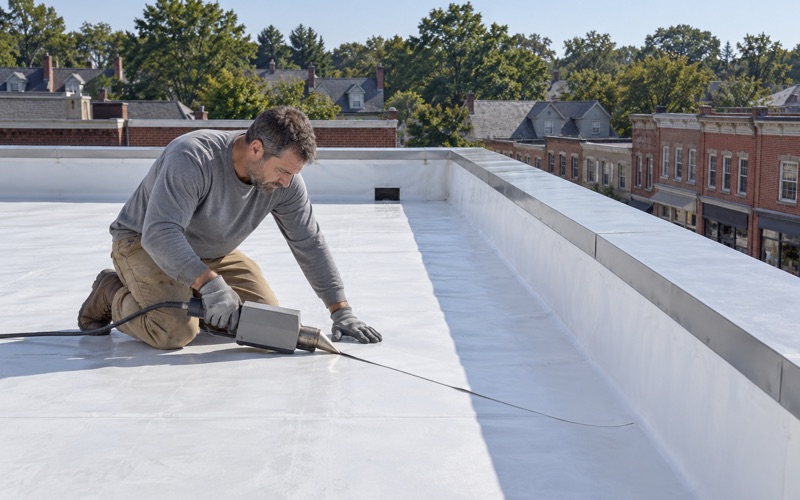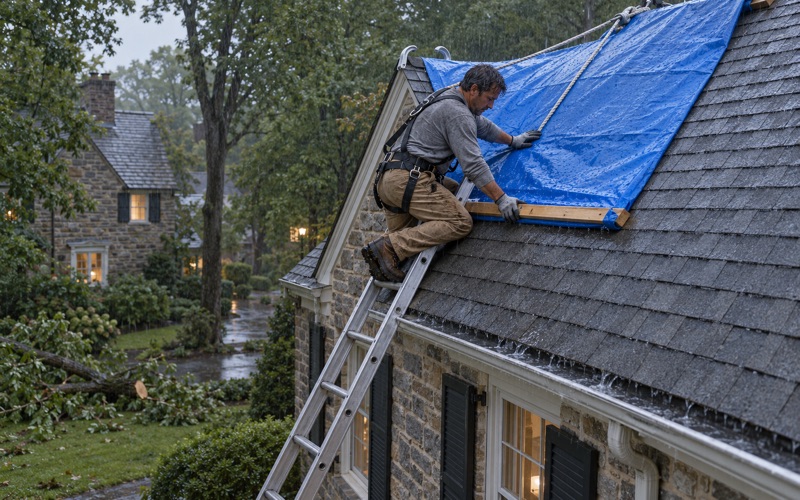
Lower Merion Elite Roofing has spent more than 20 years on roofing in Skippack and across Montgomery County, and the question we hear most from owners near the water is not about shingle color. It is whether the job they have in mind counts as upkeep or as something larger. For a house inside a mapped flood area, that distinction shapes who signs off and how the work has to be written up.
We begin every leak call in the attic as well as on the roof, so the water is traced to the spot where it actually gets in before anything is priced. You get a plain answer on whether the roof can be repaired before replacement is raised at all. When a tear-off is the right call, the written scope breaks out tear-off, decking, underlayment, flashing, ventilation and gutters as separate lines, so it can be set beside another estimate and compared item by item.
That line-by-line scope matters more than usual here, because the cost of a job measured against the value of the house is exactly what a floodplain rule looks at. Below we walk through the two creeks that shape the township, what Ida showed about one of them, how the floodplain article treats repairs, and where the 50 percent line sits for a re-roof versus a storm rebuild.
Two Creeks and a Record Crest
The Perkiomen on the western edge
Skippack Township covers 13.97 square miles in Montgomery County, and Perkiomen Creek forms its western boundary. Skippack Creek runs through the interior of the township as well. The communities inside the township include Creamery, Lucon, Providence Square, Skippack itself and part of Evansburg.
Two waterways mean the flood question is not limited to the western edge. Whether a given lot falls inside a mapped flood area is a question for the map, not for distance from the Perkiomen. We never assume a house is clear of the floodplain rules until someone has actually looked it up.
What Ida did to the Perkiomen
In the remnants of Ida on September 1-2, 2021, six to eight inches of rain fell across Montgomery County. The county’s Department of Public Safety reported that the Perkiomen Creek and the Schuylkill River both crested at all-time record levels. For anyone roofing a house along that boundary, the record crest is the reason the flood map deserves a careful read.
WHYY reported that the storm destroyed an estimated 70 homes across the Perkiomen watershed. That is a watershed figure, and we have not seen a damage count specific to the township. It still tells an owner that the flood map along this creek describes something real rather than something theoretical.
The county’s flood study
Montgomery County’s Perkiomen Mapping and Flood Mitigation Study, completed in fall 2025, covered the 362-square-mile watershed and identified more than 130 flood sites, prioritizing 20 of them. The study is a county planning document and does not replace the township’s own flood map. It does show how closely the county now watches the creek after Ida.
Looking for roofing closer to Towamencin? See Roofing in Towamencin.
Minor Repairs and the Floodplain Permit
The floodplain article
Skippack’s floodplain rules sit in Article VI of the township zoning chapter, Sections 200-71 through 200-80, added by Ordinance 352 and effective February 10, 2016. Section 200-72B makes it unlawful to undertake any construction or development in a floodplain area without a permit from the floodplain administrator.
The identified floodplain is the set of special flood hazard areas in FEMA’s Flood Insurance Study and Flood Insurance Rate Maps dated March 2, 2016, along with later revisions. That takes in the floodway and the AE, A and AO/AH areas shown on those maps.
What counts as a minor repair
The same section says a permit is not required for minor repairs to existing buildings or structures. The article defines a minor repair as the replacement of existing work with equivalent materials for the purpose of its routine maintenance and upkeep. It excludes cutting away walls or partitions, removing structural beams or bearing supports, altering required exits, and certain plumbing, gas or electrical work.
The definition speaks of equivalent materials and routine upkeep, and it does not mention roofing by name. We treat the fit of a particular roof job as a question for the floodplain administrator about that specific house, not one for a contractor to settle. So we do not promise any Skippack owner in a mapped zone how the township will classify a re-roof.
How we write the scope for a flood-zone house
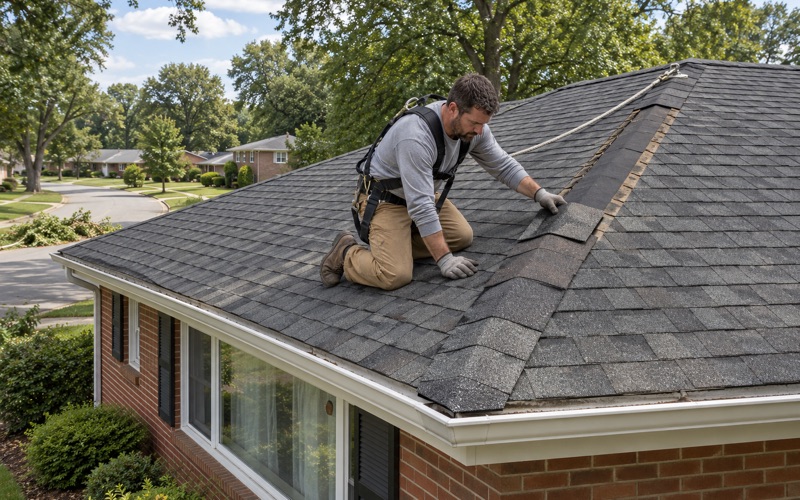
Because the definition turns on equivalent materials, our scope for a house in a mapped zone states plainly what comes off and what goes back on. If the existing covering is architectural shingles and the new one is architectural shingles over the same deck, the scope says exactly that.
If the plan changes the material, replaces framing or adds to the structure, the scope says that too. The owner can then take a clear description of the work to the township, with the facts already laid out, rather than a single lump price that hides what is being done.
The 50 Percent Line: Re-Roof Versus Storm Rebuild
How substantial improvement is measured
The article defines a substantial improvement as any reconstruction, rehabilitation, addition or other improvement whose cost equals or exceeds 50 percent of the structure’s market value before the work starts. A related term, substantial damage, applies when restoring a damaged structure would cost at least 50 percent of its market value before the damage.
The definition also reaches structures already counted as having substantial damage or repetitive loss, regardless of the actual repair work performed. A house with that history can fall on the substantial improvement side of the line even when the job in front of it looks modest.
A planned like-for-like re-roof
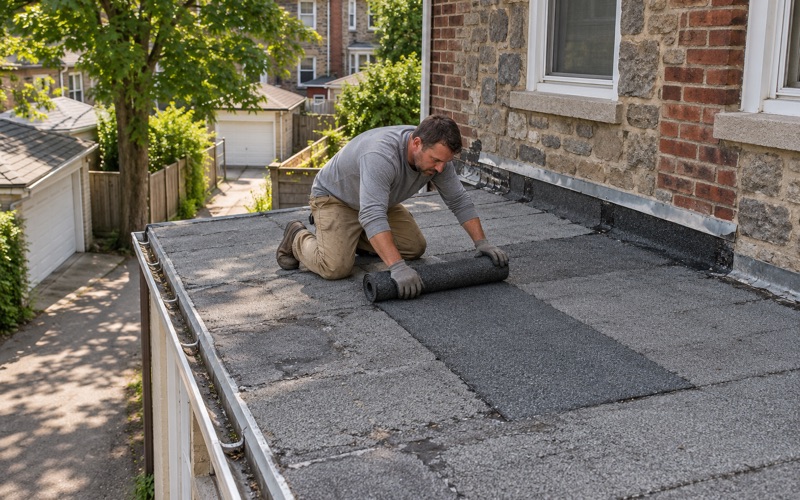
A planned re-roof on a sound house swaps one covering for another and usually leaves the framing alone. Where its cost lands against the market value of the structure is something only the real numbers can answer. That is one more reason we price each line separately instead of quoting a single figure.
On a house with no damage history and no change of material, the floodplain question for that kind of job is usually the minor-repair one above. Even then, the township’s own roofing permit still applies, which we cover in the next section.
A storm rebuild
A roof torn open in a storm, with water through the ceilings and framing exposed, is a different job. Once restoration takes in rafters, sheathing, interior finishes and mechanical work, the cost can move toward the 50 percent threshold, and the substantial damage definition was written for that situation.
We photograph storm damage and write it up for the owner’s own insurance claim, and we will meet the adjuster on site when asked, without negotiating the claim. The same photos and line items give the township a clear record of what was damaged and what restoring it costs.
Repetitive loss and earlier flooding
If a house has flooded before, it is worth asking the township whether it is already on record as a repetitive loss or substantially damaged structure. Under the article’s definition, that history can carry even a routine-looking project into the substantial improvement category, so we would rather the owner learn it before the schedule is set.
Checking the Map and the Permit Before a Big Roof Job
Start with the March 2016 map
The first step on any large roof project near either creek is to find the house on the FEMA map dated March 2, 2016, or a later revision. If the lot sits outside the special flood hazard areas, the floodplain article does not reach it and the job follows the ordinary roofing rules.
If the lot sits inside, the owner should know before the tear-off is scheduled rather than after. A conversation with the floodplain administrator, with our written scope in hand, is how the floodplain permit question gets settled for that house.
Skippack’s own re-roofing sheet
Separate from the floodplain article, the township’s re-roofing sheet says permits are required for performing roofing work. It applies Chapter 9 of the 2018 International Residential Code, Sections R902 through R905.2.8.5, and quotes the R907.3 conditions that require removing every existing layer. The township building office is at 4089 Heckler Road.
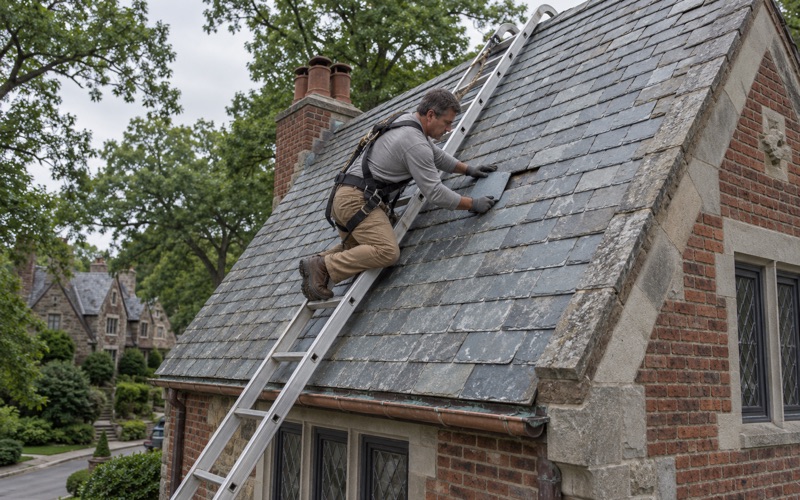
A new covering cannot go over a roof that is water-soaked or deteriorated, that is wood shake, slate, clay, cement or asbestos-cement tile, or that already has two or more applications. If more than 25 percent of the wood sheathing is compromised, rotted or expected to be replaced, a formal building permit goes to the Building Code Official for review and approval.
Sheathing, fees and the order of work
The 2026 fee schedule lists residential reroofing at $100.00 for shingles only and $250.00 with sheathing replacement, and permit fees for work started before approval are doubled. On a house that has taken on water, the decking is often worse than the shingles suggest. When the old roof comes off, we photograph any damaged decking and show it to the owner before replacing it, at a per-sheet price already set in the contract.
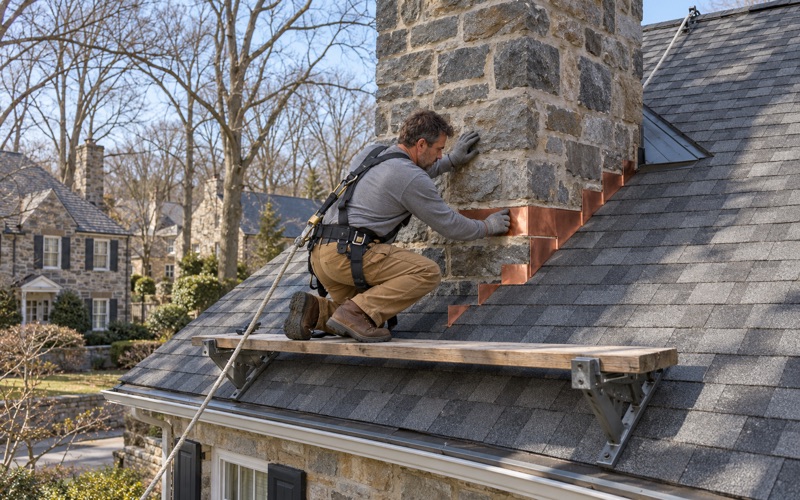
Our contracts follow Pennsylvania’s home improvement law, including the three-business-day cancellation notice and deposits kept within the legal limit. Step, counter and chimney flashing is replaced with the new roof rather than reused, and the driveway, yard and gutters are cleaned at the end of each work day with a magnet sweep for nails.
- 20+ Years Roofing
- Itemized Written Scopes
- Slate Repair Specialists