Lower Merion Elite Roofing brings more than 20 years in the trade to roofing in Towamencin, and the first thing we settle on any job is what kind of roof we are actually dealing with. A steep shingle roof on a split-level and a flat roof over a loading dock fail in different ways. They are permitted on different checklists, and they need different maintenance plans.
That distinction matters more here than in most of the area. The township has approved several very large flat roofs over the last few years, and the questions those roofs raise, about warranties, inspections and the line where new roofing meets old, are the same ones the owner of a smaller commercial building or a house with a low-slope rear section should be asking.
We give a straight answer on whether a roof can be repaired before replacement is ever on the table, and a leak call always includes a look at the underside of the deck so the water is traced to its real entry point. Our written scope breaks tear-off, decking, underlayment, flashing, ventilation and gutters into separate lines, so a second estimate can be laid beside ours and compared item by item.
Towamencin’s New Warehouse Roofs on Wambold Road and Delp Drive
Towamencin Township keeps a land-development page, and it lists the large industrial roofs the township has added recently. The township describes the Core5 warehouses on Wambold Road as 591,360 square feet in three buildings, approved in 2020. Two of the three have been built, and an amended plan for the third was approved in summer 2025, with construction ongoing.
The Core5 buildings on Wambold Road
Listings for the Core5 Logistics Center at Park 31 break that total into Building A at about 199,360 square feet, Building B at about 196,560 square feet and Building C at about 191,447 square feet. Distribution buildings like these are typically single-story, so nearly all of that floor area sits directly under roof.
We have not worked on any of these buildings, and no listing we read named the roof membrane or a warranty for them. What the numbers do show is scale: a leak on a roof that size can start far from where the water finally drips, and finding it takes a methodical walk of the field, the seams and every penetration.
The Delp Drive warehouse
The township’s page reports that construction of the 266,880-square-foot Delp Drive warehouse is complete by spring 2026, with the final intersection improvements delayed by conflicts with a water main. A finished building of that size moves quickly from a construction project to a property someone has to maintain, and the roof is usually the first system where that handoff shows.
In its first years a new roof sits under whatever warranty came with it, and the owner’s main job is keeping that coverage intact. That means documented inspections, prompt reporting of damage, and no unapproved cuts into the roof by outside trades.
What these projects mean for smaller owners
Most roofs in Towamencin are not warehouses. Census figures put 3,716 of the township’s 7,559 housing units in detached houses and another 1,644 as single-family attached homes, and owners of smaller commercial buildings face the same questions as the big distribution centers on a far smaller scale. A low-slope roof of any size is maintained on a schedule, and its weak points are the seams, edges and penetrations rather than the open field.
Looking for roofing closer to Cinnaminson? See Roofing Services in Cinnaminson.
Low-Slope Roofs on Single-Story Distribution Buildings
Why low-slope roofs behave differently
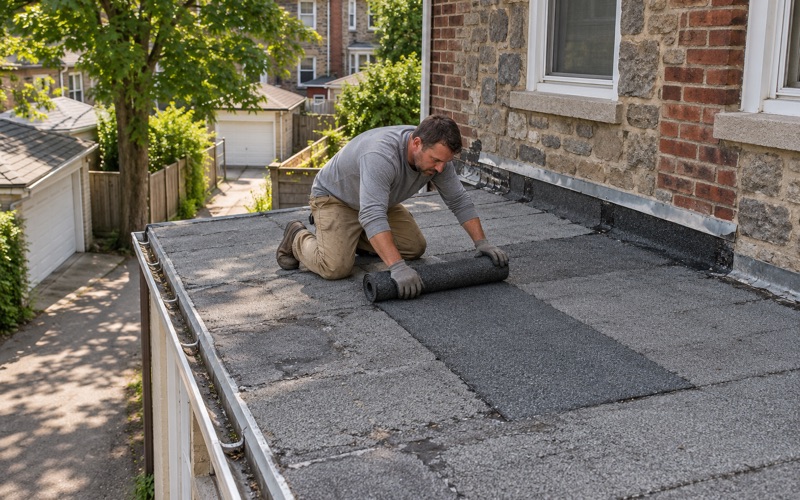
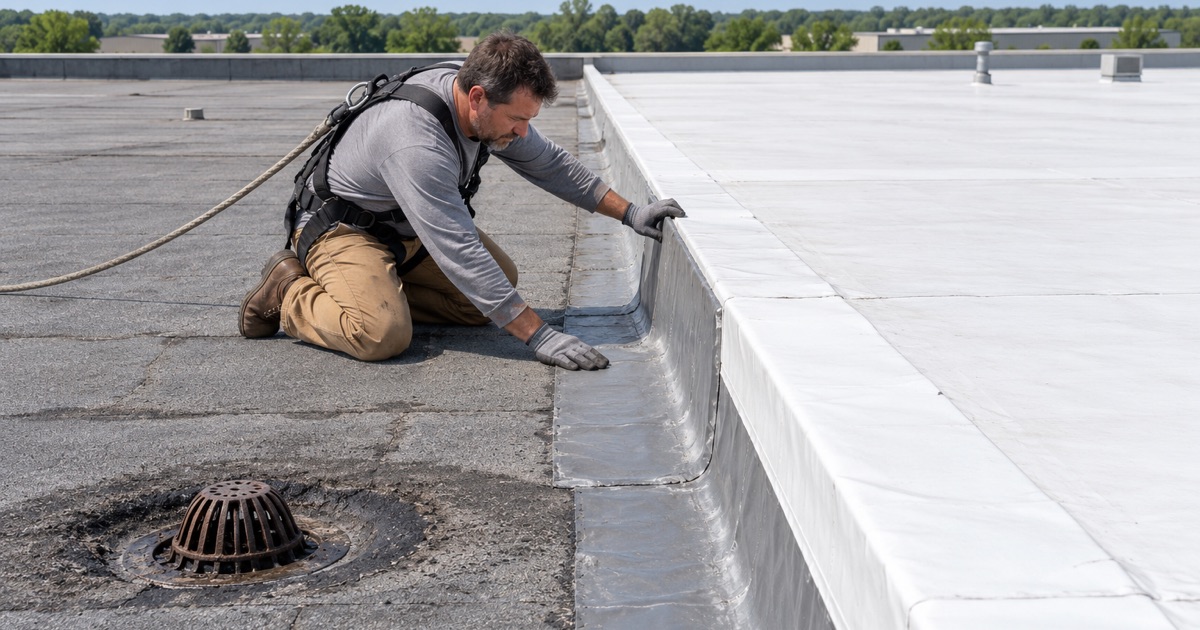
A low-slope roof does not shed water the way a pitched shingle roof does. It relies on a continuous membrane, on tapered insulation or structural slope to move water toward drains or scuppers, and on every curb, edge and penetration detail staying sealed. Ponding that lingers long after a storm is a sign the drainage plan is not working as built.
On a single-story distribution building the roof also carries a lot of equipment. Rooftop units, exhaust fans, skylights and the paths service crews walk all puncture or load the membrane, and each one is a place where a leak can begin years after the roof itself was finished.
Where we look first on a flat roof
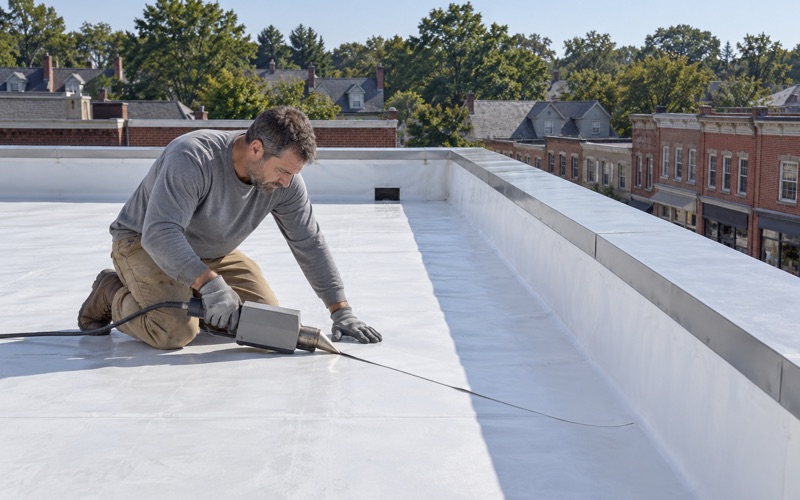
When we are called to a low-slope leak, we work from the inside as well as on top. Stains on the underside of the deck, wet insulation and the location of the drip are traced back toward the likely entry point before any patch is priced, because water on a flat roof can travel a long way along the deck before it shows.
On top we check perimeter edge metal, curb flashings, pipe boots, drains and the seams between sheets. We write up what we find with photographs, and we tell the owner plainly whether a repair will hold or whether that section has reached the end of its life.
Winter watch in the Western Montgomery zone
Towamencin falls in the National Weather Service’s Western Montgomery forecast zone, issued from the Mount Holly office, and the point forecast for the township reads as Kulpsville. That is a forecast zone, not a climate record. It is still the place a building owner should watch winter storm warnings, because snow drifting against rooftop units and walls adds load and leak risk to any flat roof.
New-Roof Warranties, Inspections and Additions at Forty Foot Road
Keeping a new roof’s warranty intact
A new commercial roof normally comes with a manufacturer or installer warranty, and its terms shape much of the maintenance plan. Many such warranties expect regular inspections, a record of them, and notice before another contractor cuts into the roof for a new unit or penetration. An owner who lets a mechanical contractor add a curb without telling the warranty holder can find that area excluded later.
We read the warranty before we touch a warranted roof, and if a repair falls under it we say so rather than doing the work ourselves. Where a roof is out of warranty, our written scope lists the repair, the flashing, any decking and the drainage work separately, so the owner can see exactly what is being bought.
An inspection schedule that fits a big roof
A sensible routine is one walk in spring and another in fall, plus a look after any major wind or hail event. Each visit should clear drains and scuppers, check the seams and the flashing at every unit, and note anything other trades have installed since the last walk.
Keeping the reports in one file matters as much as doing the walks. When a claim or a warranty question comes up years later, a dated photograph showing a seam was intact the previous fall is worth more than anyone’s memory.
Tying an addition into an existing roof
The township’s page notes that RB Distribution, at 890 Forty Foot Road, is constructing a 50,000-square-foot addition to its existing building, with conditional use approved in spring 2026 and land development review underway. Whatever the building, the seam where a new roof meets an old one is where an addition most often leaks.
That joint has to handle two roofs that may move differently, two drainage plans that must agree, and often two warranties that each stop at the line between them. We plan a tie-in so water from the old roof is not pushed onto the new one, the flashing at the junction is new rather than reused, and the owner knows which coverage applies to which side.
Towamencin’s Roofing Permit and Its Commercial Checklist
What the township asks for on every job
Towamencin Township Code Enforcement, at 1090 Troxel Road in Lansdale, issues a dedicated permit for roofing and siding replacement on single-family homes and multi-family buildings. The form, revised in April 2025, asks for the development name, the type of rated separation and the number of rated wall and floor separations per building. It also requires a final inspection.
The residential checklist asks for compliance with the 2015 International Residential Code, the roof slope, spec sheets for the underlayment and the roofing material, the flashing material, and an ice barrier extending 24 inches minimum inside the exterior wall line at the lowest roof edges. Those are the township’s own requirements rather than a statewide rule, which is why we check the rule for each property’s municipality before pricing the job.
What the commercial checklist adds
For commercial roofs, the township’s checklist adds roof insulation and fire classification to the residential items. On a low-slope building neither is a paperwork detail, because the insulation often forms the slope that carries water to the drains, and a fire classification describes the whole roof assembly rather than its top layer alone.
We gather that information before an application goes in, so a commercial re-roof here is not held up waiting for a spec sheet. The township lists a permits email address but does not accept applications through it, and it asks for at least 24 hours notice for every inspection.
Scheduling, storm damage and cleanup
We build the final inspection into the schedule from the start, and flashing at walls, curbs and edges is replaced with the roof instead of being reused under new material. At the end of each work day the site is cleaned, including a magnet sweep of the lot and landscaping for roofing nails, which matters on a property where trucks and staff park every morning.
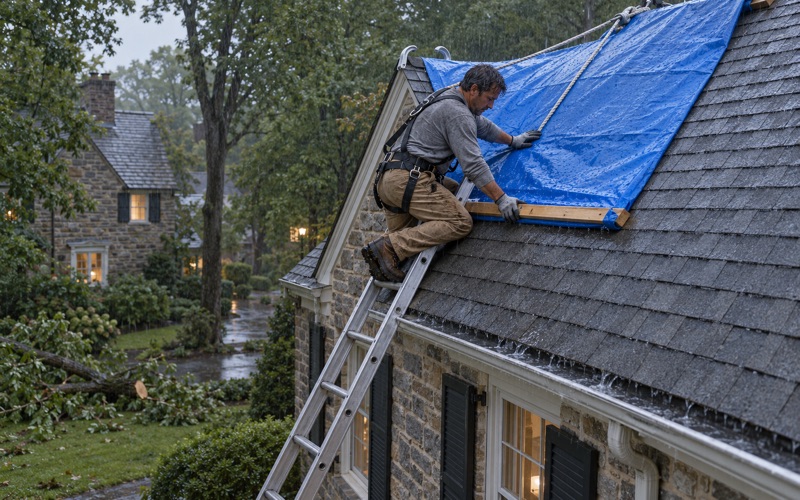
If storm damage brings us to a Towamencin building, we photograph it and write it up for the owner’s own claim, and we will meet the adjuster on site when asked. We do not negotiate the claim itself; that stays between the owner and the insurer.
- 20+ Years Roofing
- Itemized Written Scopes
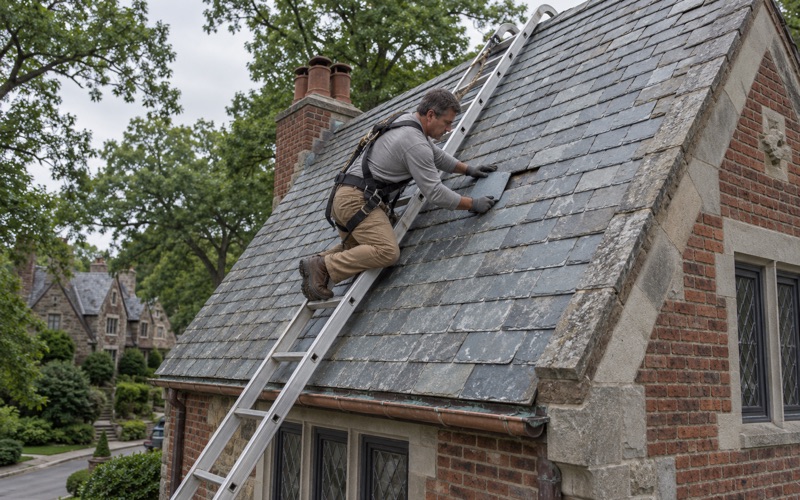
- Slate Repair Specialists