Lower Merion Elite Roofing brings more than 20 years in business to roofing in Upper Chichester, and the work that matters most after a big snow is finding out what the storm actually did. Our leak calls start in the attic as well as on the roof, so water is traced to the spot where it gets in before any price is put on paper. That habit pays off after snow, when a ceiling stain can sit well away from the opening that let the water through.
We tell you plainly whether a roof can be repaired before anyone talks about replacing it. A heavy snowfall rarely finishes a whole roof; far more often it exposes one weak valley, a tired run of flashing or a gutter that was already pitched wrong. When a full replacement does make sense, the written scope breaks out tear-off, decking, underlayment, flashing, ventilation and gutters as separate lines you can hold against any other estimate.
This page covers what a declared storm means for a roof in this township: the weight left on the deck, the gutters that pack solid, the ice that builds at the eaves and the leak check that belongs after the thaw. It also covers what to fix ahead of the next storm, so the next declaration finds the house ready rather than surprised.
Upper Chichester’s February 2026 Declaration and the Snow It Answered
A Declaration Issued Before the Storm
On February 22, 2026, before Winter Storm Hernando reached Delaware County, the Upper Chichester Board of Commissioners, working with the Emergency Management Coordinator and the Township Manager, issued a Declaration of Disaster Emergency. The township readied its Emergency Operations Center to open once the storm began and fully staffed police and public works. Residents were told to follow the parking and driving restrictions of Chapter 555, Article VI of the Township Code before, during and after the storm.
Six snow emergency routes were named, including Chichester Avenue, Route 322 and Market Street, which carries Route 452. The township’s post covered those routes, the operations center and schedule changes for February 23, and it reported no damage. It did not mention roofs, and nothing in it told homeowners to clear them.
Ten Inches at Boothwyn by Morning
By the morning of February 23, reported totals stood at 10.0 inches at Boothwyn and 9.5 inches in Upper Chichester, according to a WHYY and 6abc roundup published the next day that does not name its observers. The same regional storm left 14 inches at Philadelphia International Airport. Those figures describe snow on the ground rather than what any one roof carried, but they give a fair sense of the depth that settled on decks across the township overnight.
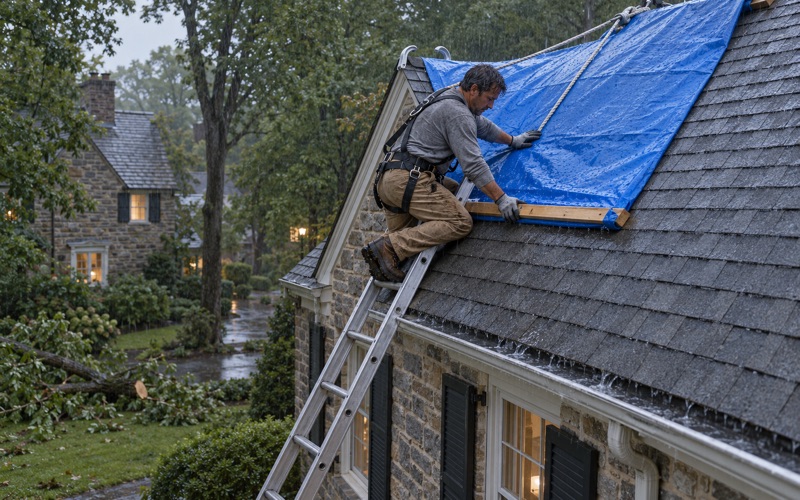
A roof facing that depth has three problems rather than one: the load sitting on the deck, the gutters that fill and freeze, and the ice that forms at the eaves once the attic starts warming the snow from below. Each one shows itself on a different day of the storm and the thaw, which is why we check them in that order.
What the Declaration Means for Roof Work
A disaster declaration is a public signal that a storm is expected to strain roads and services, and it is a good prompt to think about the roof the same way. The parking rules and emergency routes keep plows moving, which also means a contractor’s truck may not be able to stop on Chichester Avenue or Market Street until the restrictions lift. Planning around that is part of scheduling winter work here.
The township post also told residents to leave and call 911 if they found downed lines or smelled gas, and it listed PECO numbers. A service line pulled down by ice sliding off a roof edge belongs to PECO, not to a roofer, and we will not work near one until the utility has made it safe.
Looking for roofing closer to Overbrook? See Roofing in Overbrook.
Snow Weight, Packed Gutters and Ice at the Eaves
The Weight on the Deck
Snow load is not one number for the whole township. Design snow load is set by the address, so we do not quote a town-wide figure, and we will not guess at what a particular roof was built to carry. What we can do is look at what the snow found: sagging between rafters, a soft spot in the decking or a ridge line that no longer runs straight.
Of Upper Chichester’s 6,738 housing units, 4,384 are detached houses and 1,303 were built in the 1950s, according to the Census Bureau’s 2024 five-year estimates. A roof on a house that age may have been covered more than once, and every extra layer adds weight before any snow lands. When we find a second layer on a house we are asked to re-roof, the scope says up front whether a tear-off is required.
Gutters Packed Solid
Ten inches of snow on a roof slope ends up in the gutters one way or another. As it settles and partly melts, it slides into the troughs and freezes there, and a run of gutter full of ice is heavy enough to pull hangers loose and bend the front lip outward. Downspouts packed with ice stop draining altogether, so the next melt has nowhere to go but over the edge or back toward the fascia.
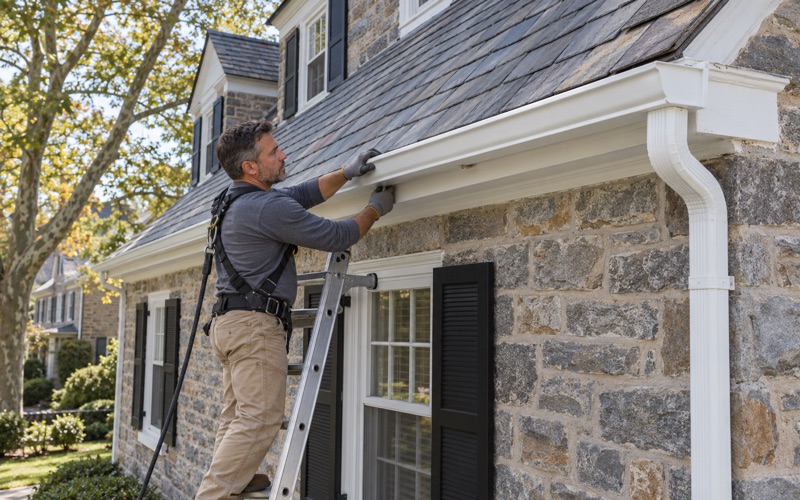
We size and pitch gutters and downspouts along with the roof rather than treating them as an add-on. A gutter set with steady fall toward an outlet that can carry the water empties faster on a thaw day and holds less to refreeze overnight. After a storm like Hernando we check the hangers, the seams and the outlets, and we look at whether the fascia behind them took on water.
Ice That Forms at the Eaves
The third problem is the one most likely to put water inside after a snow. When attic heat warms the underside of the roof, the snow above it melts, runs down to the eave and refreezes over the cold overhang. The ridge of ice that builds there, usually called an ice dam, holds back the next round of meltwater, which can then work up under the shingles.
The cures sit at the attic floor and at the eave. Air sealing and insulation keep house heat out of the attic, a ridge vent with balanced soffit intake keeps the deck cold, and a self-adhering ice and water barrier under the first courses gives backed-up water no way in. We look at all three together, because adding vents to an attic that leaks warm air from the rooms below seldom fixes the problem.
Finding a Leak After the Thaw
Where to Look Inside
The days after a big thaw are when stains appear. Check the ceilings along exterior walls, the tops of walls under the eaves, the areas around skylights and chimney chases, and the closets on the top floor. A brown ring that grows after a sunny afternoon and stops overnight points to meltwater rather than a constant opening.
In the attic, look for wet or darkened sheathing near the eaves, frost on nail tips and damp insulation along the outer edge. Take photos and note the date for each one. That record helps us match what you saw to what we find on the roof.
Valleys, Eaves and Flashing
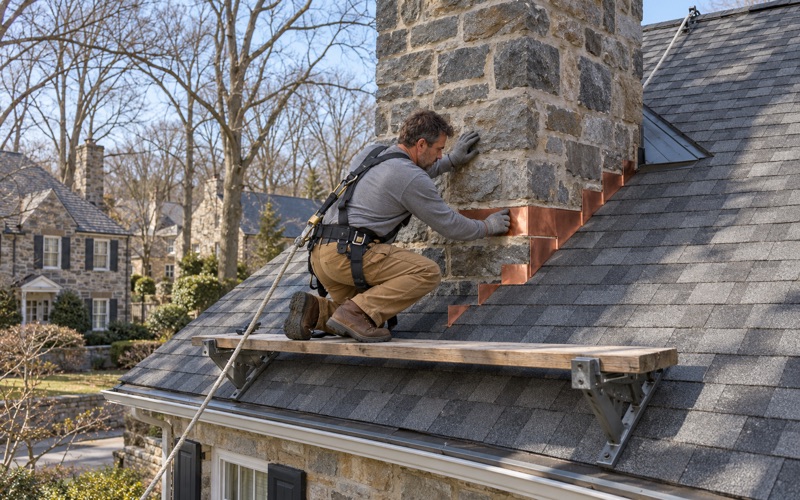
Valleys gather the most snow and drain the most meltwater, so they are where worn underlayment or a lifted shingle shows up first. Eaves fail where ice backed water under the courses. Chimneys, sidewalls and skylights fail at the flashing, where a step or counter flashing joint has opened.
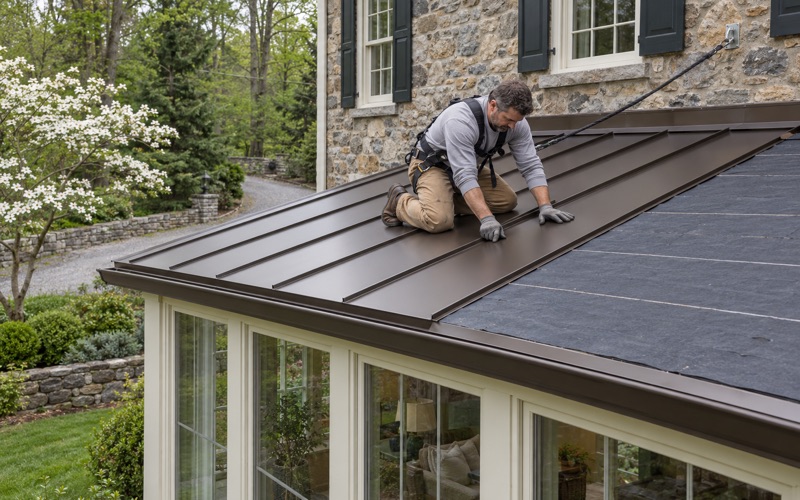
When we replace a roof, step, counter and chimney flashing are replaced with it rather than reused under new material. On a repair, we tell you whether the existing flashing can be resealed or whether a patch would only move the leak a few feet over.
Tracing Water From the Attic Up
Water travels along rafters and across the top of the ceiling drywall before it drips, so the stain and the opening are often feet apart. We start in the attic, follow the trail upslope, and only then go onto the roof to confirm the source. That way the price covers the place the water actually enters rather than the place it happened to land.
If the storm did leave damage you plan to claim, we photograph it and write it up for your own claim, and we will meet the adjuster on site if you ask. We do not negotiate the claim; that stays between you and your insurer.
Getting the Roof Ready Before the Next Declared Storm
What to Fix in the Fall
The best time to prepare for a declaration is months before one is issued. Clean the gutters after leaf fall, confirm each downspout runs clear to the ground, and have soft decking, missing shingles or lifted flashing dealt with before the first hard freeze. A roof that goes into winter sound has far less to lose when ten inches lands on it overnight.
If ice built at the eaves last winter, fall is also the time to look at attic ventilation and air sealing. Those fixes usually cost less than a ceiling repair, and they work on every storm that follows rather than only the next one.
Emergency Repairs and the Township’s Permit Rules
Upper Chichester enforces the Pennsylvania Uniform Construction Code through a third-party agency for permit approval, plan review and inspections, and its License and Inspection Department lists a building permit for an exact roof replacement. Its fee schedule says an emergency permit application must be received within 3 days of the emergency repair or replacement, and that failing to obtain a required permit doubles the fee.
Each township and borough we serve sets its own re-roof rule, so we check the rule for the house’s own municipality before pricing the job. If a storm forces a same-day repair here, we keep the paperwork moving so the application lands inside that window.
A Clear Contract and a Clean Site
Our contracts follow Pennsylvania’s home improvement law, including the three-business-day cancellation notice and a deposit kept within the legal limit. If damaged decking turns up once the old roof is off, we photograph it and show you before it is replaced, at the per-sheet price set in the contract.
At the end of each work day the driveway, yard and gutters are cleaned and a magnet is run over the ground for nails. In winter that matters more than usual, since a nail hidden under the next snowfall can still find a tire in spring.
- 20+ Years Roofing
- Itemized Written Scopes
- Slate Repair Specialists