Lower Merion Elite Roofing brings more than 20 years in the trade to roofing in Upper Providence Township, and the first thing we settle on any job here is the paperwork the township expects from the roofer. Upper Providence keeps a file on the contractors who work inside its borders, and a homeowner is entitled to ask what belongs in it before anyone sets a ladder against the house.
That file is short, and it is worth knowing in advance. For a house, it holds a copy of the roofer’s Pennsylvania home improvement contractor registration and a certificate of insurance. For a commercial roof, it holds an annual township registration, and for a crew knocking on doors, the township prices a separate permit of its own.
Our side of the job starts the same way on every call. We look in the attic as well as on the roof, so a leak is traced to the spot where water actually gets in before anything is priced. You get a straight answer on whether a repair will hold before replacement is ever raised, and we check the re-roof rule for your own municipality before an estimate is written.
Upper Providence’s Contractor File and the Residential Waiver
What Resolution 2025-36 says
The township’s 2026 Fee Schedule, adopted as Resolution 2025-36 and resolved December 15, 2025, lists a Contractor Registration with an annual fee of $100. A footnote attached to that line carries the rule that matters for most homeowners. It reads: “Contractor Registration is NOT required for residential work if contractor has a current PA Home Improvement Contractor license.”
The same note goes on to say that “A Certificate of Insurance and copy of the state license is required in lieu of fee.” So the waiver is not a blank pass. A residential roofer skips the $100 charge but still hands the township two documents, and those two documents are what put the roofer on file.
A registration, not a license
The schedule’s word is “license,” but Pennsylvania does not license home improvement contractors. Under the Home Improvement Consumer Protection Act, a contractor registers with the Bureau of Consumer Protection in the Office of Attorney General, and the statute creates a registration rather than a license. The township’s wording is its own, and the document it is asking for is that state home improvement contractor registration.
This matters when you check a roofer. A contractor who claims some separate state roofing credential is describing something the state does not issue. What you can ask for is the state registration itself, the same copy the township asks to keep.
The certificate of insurance on file
The second half of the residential file is a Certificate of Insurance. The schedule asks for it in place of the fee, so a roofer doing residential work in Upper Providence is expected to have insurance documented with the township, not just described in a sales pitch. Ask whether that certificate has been supplied and whether it covers the dates of your job.
We would add one caution. The fee schedule tells you what the township asks a contractor to supply, but it does not say what the township checks before accepting it. Being on file is a record rather than an endorsement, so the documents are worth reading yourself.
Looking for roofing closer to Nether Providence? See Nether Providence Roofing.
Commercial Roofing and the Annual Township Registration
When the $100 registration applies
The waiver stops where residential work ends. The schedule states plainly that “Commercial work requires annual registration,” so a roofer working on a commercial building in the township pays the $100 fee and renews it each year. Zoning here is 98% residential, 1% commercial and 1% industrial, so this work happens on a fairly small number of properties.
For a business owner or property manager, the practical step is to confirm that the roofer’s registration is current for the year the work is done. Because the fee is annual, ask for this year’s registration rather than accepting an old receipt as proof.
Separate permit lines for commercial roofs
Roofing is priced on its own lines in the same schedule. Commercial roofing and shingling runs $50 per $1,000 of cost, with a $300 minimum, which is double the residential rate. Work done without a permit draws a $300 commercial penalty on top of the fee.
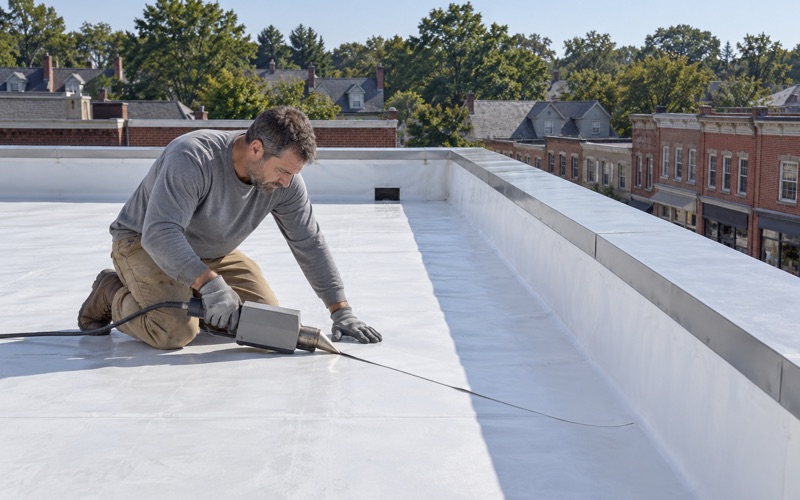
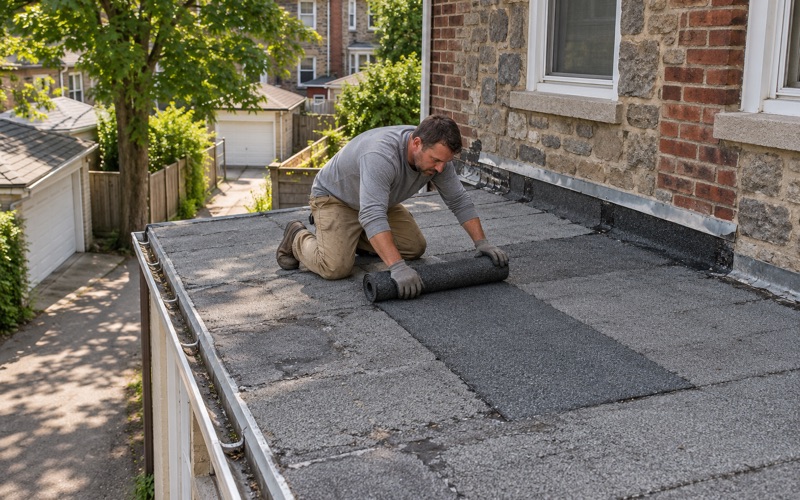
Flat and low-slope commercial roofs often call for EPDM rubber, TPO or torch-down modified bitumen rather than shingles. We write the scope with the membrane, insulation, flashing and drainage as separate lines, so the permit value and the estimate describe the same job and two bids can be compared item by item.
Door-to-Door Roofers and the Solicitation Permit
What the fee schedule prices
The township’s miscellaneous fees include a Solicitation Permit at $150 for the initial permit, which covers one solicitor, plus $25 for each additional solicitor. Renewal runs $50 with one solicitor included and $10 for each person added. A canvassing crew of several people is therefore a priced, countable item on the township’s books.
We have read only the fee line, not the ordinance text behind it. That means we cannot tell you exactly which kinds of door-to-door selling the permit reaches, or whether a roofing canvasser after a storm falls under it. The township office at 610-565-4944 can answer that question directly.
Asking a canvasser the right questions
When someone knocks offering a free roof inspection, it costs nothing to ask whether they hold a township solicitation permit. Then ask the same two questions you would put to any residential roofer: a copy of the state home improvement contractor registration, and whether a certificate of insurance is on file with Upper Providence.
A legitimate contractor can answer both without hesitation. Someone who cannot produce the state registration is a reason to close the door politely, however the permit question turns out.
Storm damage and your own claim
Door knocking tends to follow bad weather, and the pitch usually leans on insurance. Our practice is to photograph storm damage and write it up for the owner’s own claim, and to meet the adjuster on site when asked. We do not negotiate the claim, because that relationship stays between you and your insurer.
A canvasser who offers to handle the claim for you is a different matter, because in Pennsylvania adjusting a claim on a homeowner’s behalf is the work of a licensed public adjuster under the Public Adjuster Licensing Law. A roofer’s job is to document the roof accurately and quote the repair, while the settlement belongs to you and your insurance company.
Before a Roofer Starts in Upper Providence
The roofing permit and its fee
The township’s Permits and Applications page lists a Roofing Permit Application among “the permits required prior to starting any project.” Residential roofing and shingling costs $25 per $1,000 of cost with a $200 minimum, plus a $4.50 state educational fee per permit. Inspections are handled by the township’s third-party agency, Linn Architects.
Starting without the permit adds a $200 residential penalty on top of the fee, so it pays to confirm the permit is pulled before materials arrive. We put the permit in our written scope, so you can see who is applying for it and what it costs.
What the application asks of the roof itself
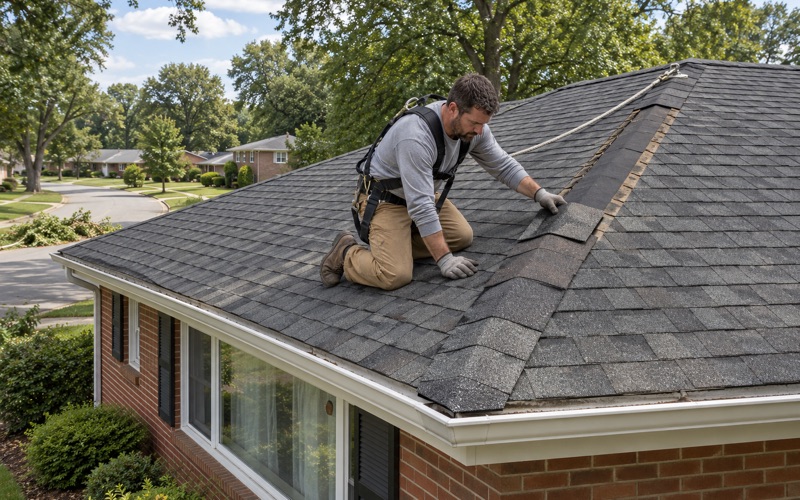
The application sets technical conditions as well. An existing covering may stay only if there are fewer than two layers, it is in good condition, and it is not slate, clay or cement tile. Slopes of 4:12 or less need double underlayment, and the ice barrier must run from the eave to 2 feet inside the exterior wall line, with pictures taken during installation.
Because the application bars a new roof over two existing layers or over slate, clay or cement tile, our estimate says up front whether a tear-off is required. That keeps a surprise tear-off charge from appearing halfway through the job, and it gives the inspector a scope that matches the work on the roof.
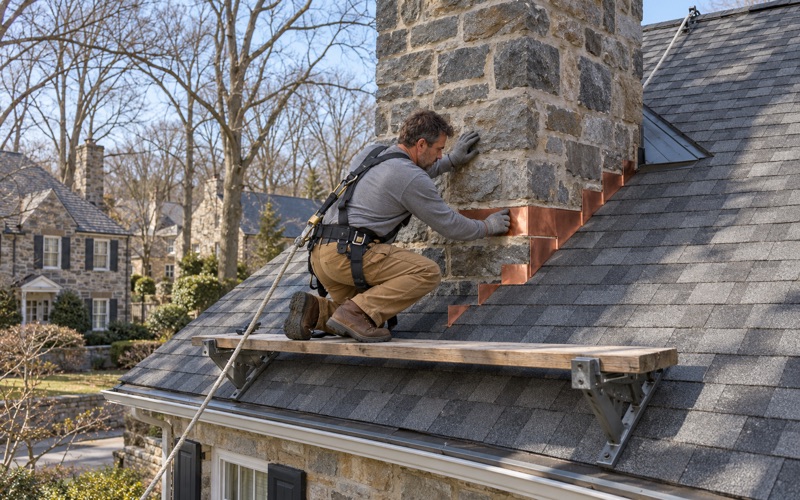
Ventilation is set at 1 to 150, so we size the ridge vent and soffit intake to that ratio rather than guessing. Step, counter and chimney flashing come off with the old roof and are replaced, never reused under new shingles.
Older houses and wooded lots
Upper Providence surrounds and lies north of the borough of Media, between Ridley Creek on the west and Crum Creek on the east, and most of Ridley Creek State Park sits in the township toward its northern edge. Of its 4,288 housing units, 3,079 are detached houses, and 362 were built in 1939 or earlier.
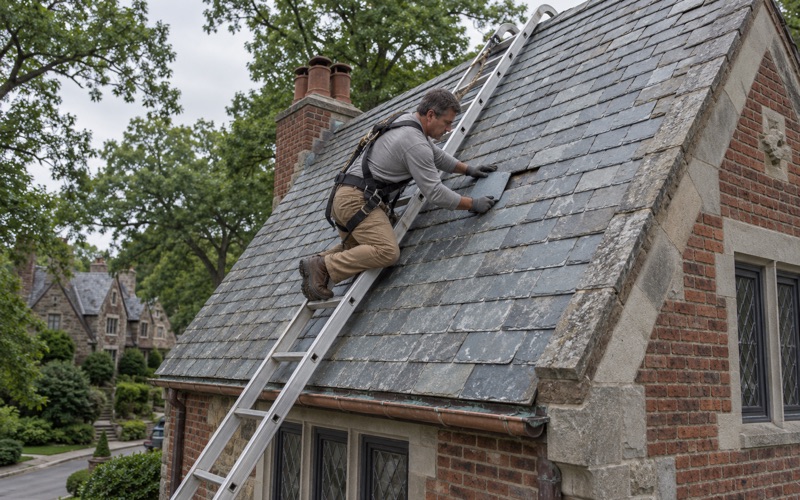
The township’s 2005 comprehensive plan notes that many residents pay a premium for a home on a wooded lot, and trees over a roof mean leaves in the gutters and shade on the shingles. We size and pitch gutters and downspouts with the roof, and when a sound slate roof turns up on an older house, we repair it slate by slate with copper nails and slate hooks before anyone discusses tearing it off.
Not every house stands alone, since 300 units are single-family attached homes and 249 of them are owner-occupied. We plan a twin or townhouse roof with the neighbor’s roof and the shared wall in mind, so the seam between the two roofs is flashed and sealed rather than left to chance.
A short checklist for the first day
Before work begins, you should be able to see three things: a copy of the roofer’s state home improvement contractor registration, confirmation that a certificate of insurance is on file with the township, and the roofing permit. If the job was sold at your door, add the solicitation permit question to that list.
On our side, the contract follows Pennsylvania’s home improvement law, including the three-business-day cancellation notice and a deposit within the legal limit. Rotted decking found under the old roof is photographed and shown to you before it is replaced at the per-sheet price written into the contract. The driveway and yard also get a magnet sweep for nails at the end of every work day.
- 20+ Years Roofing
- Itemized Written Scopes
- Slate Repair Specialists