Lower Merion Elite Roofing has spent more than 20 years on roofing in West Norriton and the rest of our Montgomery County service area, and a large share of that work starts the morning after a storm. A roof rarely fails all at once. It loses an edge, a flashing joint or a run of shingles, and then water does the rest.
This page is about that sequence: what wind does to a roof, what rain does once the wind has opened a gap, and how we check a house afterward. We give a straight answer on whether a damaged roof can be repaired before anyone mentions replacement, and we price nothing until we know where the water gets in.
If you own a twin, a townhouse or a detached house in the township and you are not sure whether the last storm left anything behind, the sections below explain what we look for and why. The goal is a roof you can trust before the next one arrives, priced on what is actually wrong.
What the Christmas Eve 2020 Storm Did to West Norriton Roofs
The wind-and-rain storm of December 24-25, 2020, is the clearest recent record of how roofs here fail. The National Weather Service office in Mount Holly summarized it as the December 24-25 2020 storm, and local reporting on Christmas Day singled this township out.
One of the Hardest-Hit Areas in the Region
CBS Philadelphia, reporting on Christmas Day, called West Norriton one of the hardest-hit areas in the region. Tens of thousands of people lost power, and a large tree ripped from its roots fell into an intersection and snapped a utility pole.
The roof damage in that report was specific. A crew was repairing a roof across Egypt Road that a resident said had peeled like a banana. Another homeowner said the roof had peeled back over her children’s upstairs bedroom and the ceiling was now leaking, and a chimney had come down onto a car and a driveway. The repair crew on scene was on its second of four calls that day.
Wind and Rain Arriving Together
What made Christmas Eve 2020 hard on roofs was that the rain came with the wind. One resident described sideways rain, and another found water in his basement. A roof edge that lifted at night did not sit dry until morning; it leaked the same night.
No wind speed was measured or estimated for the township in any source we have read, and no count of damaged roofs exists. What the record does show is the pattern, and the pattern is what we check for on every storm call.
The River Rose by Morning
The same storm pushed the Schuylkill River at Norristown to a crest of 14.52 feet by 6:30 the next morning. The weather service impact list for that gauge says flooding occurs in West Norriton at 12.5 feet, and at 13 feet water begins to cover and close Riverview Boulevard.
That matters to a roofing call because a household dealing with water in the basement often does not get to the attic for days. A small ceiling stain found a week later can still trace back to that night.
Looking for roofing closer to Easttown? See Easttown Roofing.
Roofs That Peeled Back: Edges and Chimneys
A roof that peels like the one on Egypt Road almost always starts at an edge. Wind moving over a roof pulls upward hardest at the eaves, the rakes and the corners, and once one course lets go, the next one has nothing holding it down.
Why Roofs Fail From the Edge
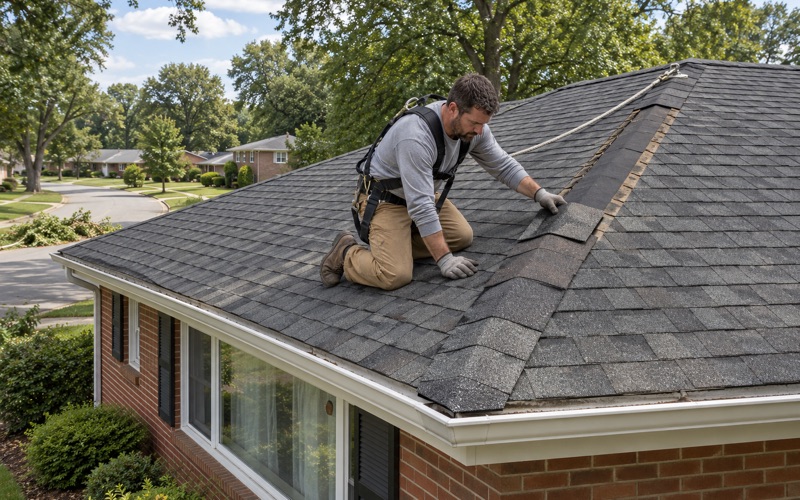
Asphalt shingles are held by nails and by a sealant strip that bonds each course to the one below. On an older roof the sealant can let go, and a lifted tab becomes a lever for the wind. A missing or loose drip edge at the eaves and rakes gives the wind a place to get under the first course.
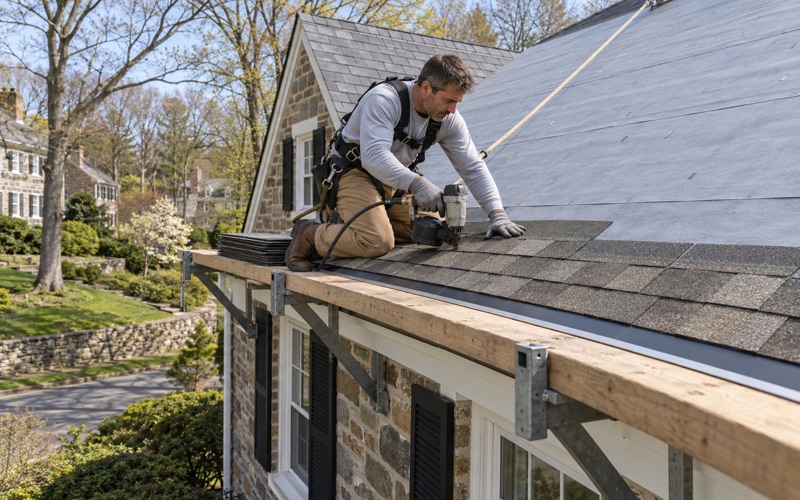
When we replace a roof here we specify shingles rated to ASTM D3161 Class F or ASTM D7158 Class H for wind, along with new drip edge and starter strip at every edge. Architectural shingles such as GAF Timberline HDZ, Owens Corning Duration and CertainTeed Landmark carry those ratings when installed to the manufacturer’s nailing pattern.
Reading a Partial Blow-Off
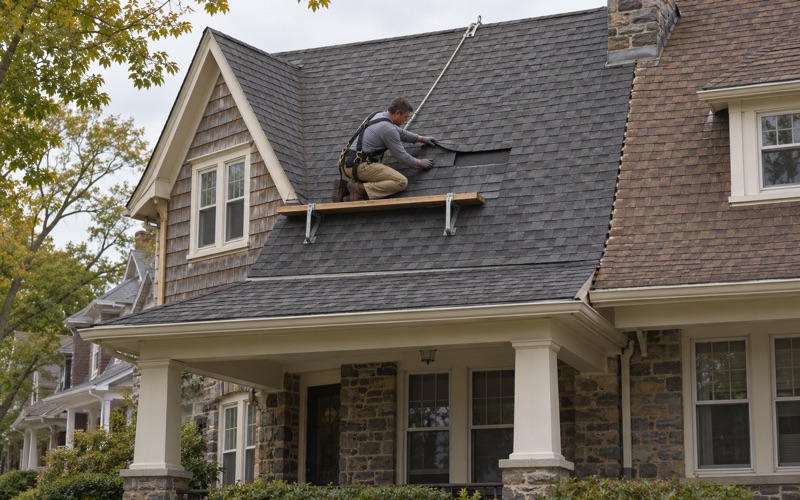
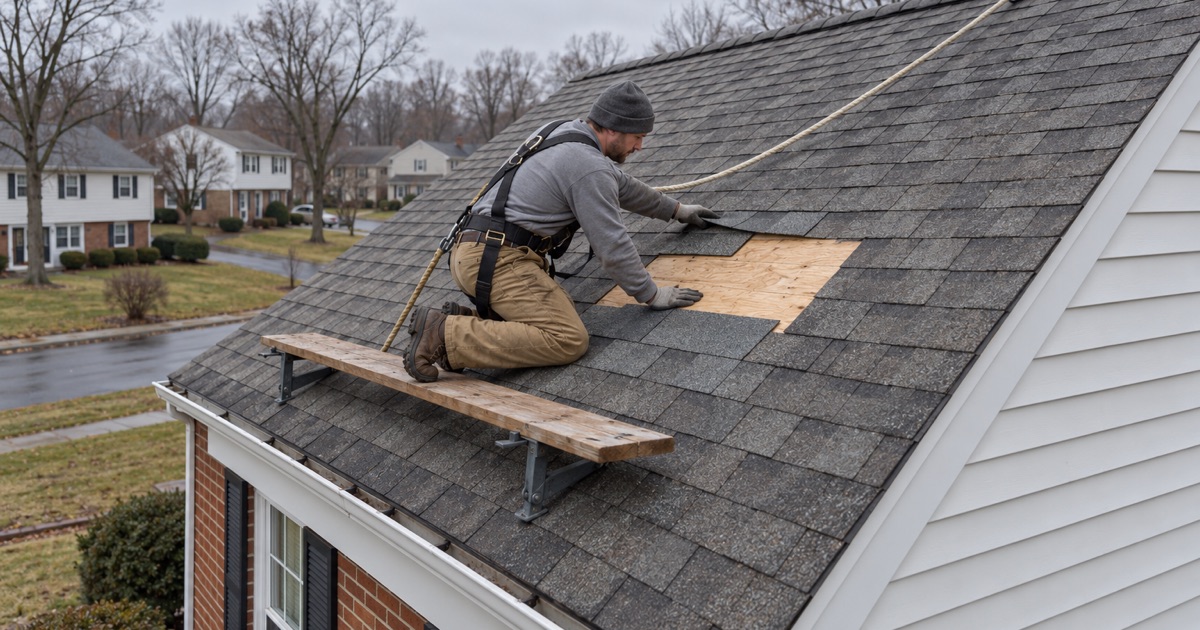
A section that peeled back is not always a reason to replace the whole roof. If the decking is sound and the surrounding shingles still seal, a matched section repair can be the right answer, and we say so plainly.
If the shingles around the damage crack when lifted, or the decking under them is soft, a patch will not hold through the next storm. We photograph what we find, show it to you, and explain why the scope reads the way it does.
Chimneys in a Wind Storm
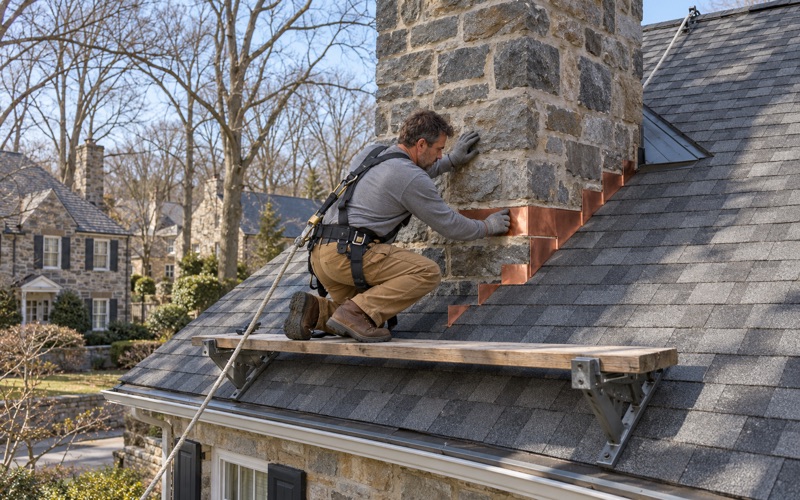
A chimney that falls onto a car and a driveway, as one did that Christmas Eve, is an extreme case. Far more often a chimney survives the storm and its flashing does not. Wind loads the stack, the mortar joints work loose, and the seal between masonry and roof opens just enough to let water run down the outside of the flue.
We look at the cap, the crown, the mortar and the flashing together. A chimney that has shifted or lost mortar needs a mason before it needs a roofer, and we will tell you when that is the order of work.
Flashing That Gets Replaced, Not Reused
Step flashing, counter flashing set into a reglet, and the chimney cricket behind a wide stack are the parts that keep water out where the roof meets masonry. On a replacement we install new step, counter and chimney flashing rather than bending old metal back into place under new shingles.
Old flashing reused under a new roof is one of the most common reasons a nearly new roof leaks at the chimney. Replacing it costs less now than tearing open a finished roof later.
Rain Behind the Wind: When a Lifted Roof Becomes a Ceiling Leak
The bedroom ceiling that leaked on Christmas Day is the usual outcome when wind and rain arrive together. Wind opens the roof and rain finds the opening within minutes, which is why storm damage so often shows up indoors before anyone sees it from the yard.
How Water Reaches a Bedroom Ceiling
Once shingles lift, water runs across the underlayment and into the nail holes, seams and edges below. Felt underlayment soaks through quickly, and synthetic underlayment to ASTM D8257 sheds water longer but still leaks at fasteners once exposed. From there water follows rafters and sheathing before it drips, so the stain on the ceiling is often several feet from the actual opening.
That is why we never price a leak repair from the ground or from the ceiling alone. We trace the water to where it actually gets in.
Tracing the Leak From the Attic
Every leak call we take includes a look in the attic as well as on the roof. In the attic we look for wet sheathing, dark staining on rafters, rusted nail tips and damp insulation, and we follow the trail uphill to its source.
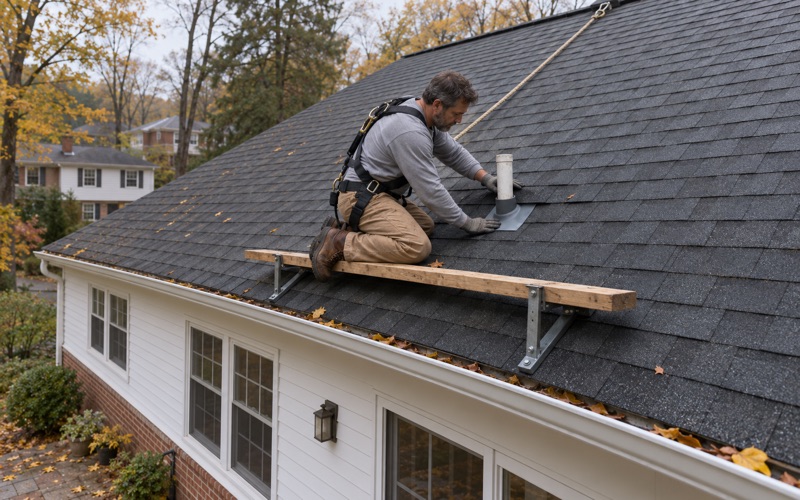
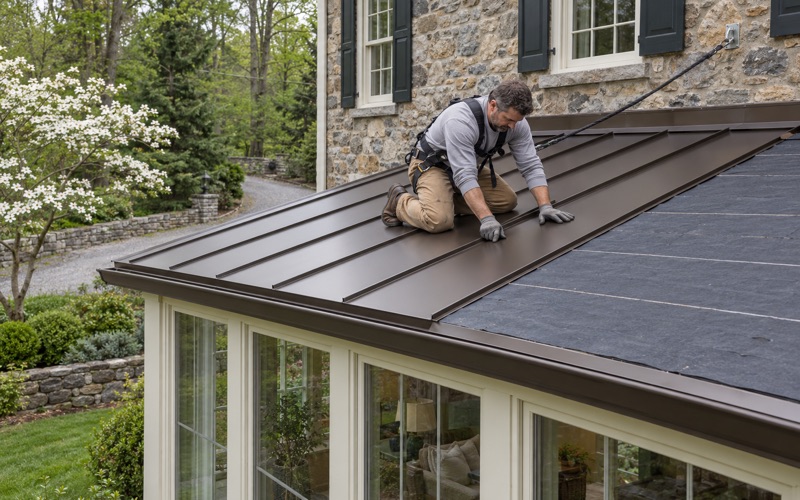
On the roof we match what we found inside to what is visible outside: a lifted course, a torn pipe boot, open step flashing at a sidewall. Only when the two line up do we write a repair scope.
Keeping Water Out Until the Repair
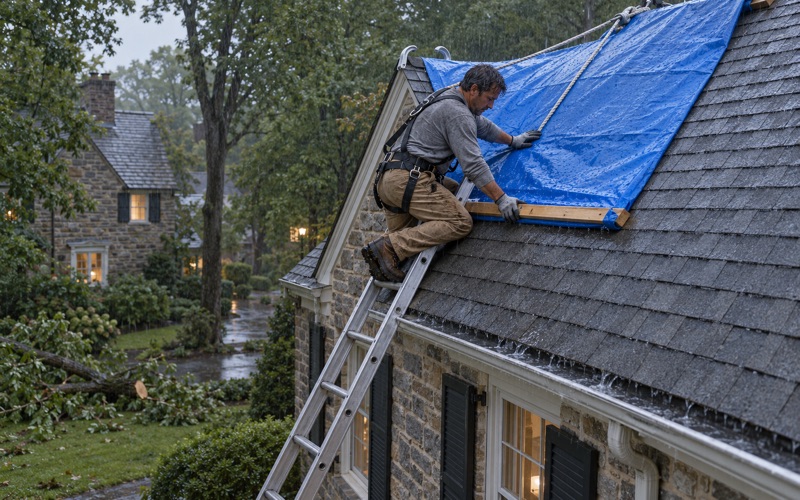
On the night of a storm the job is to stop water, not to rebuild. A properly fastened temporary cover over the damaged area protects ceilings and insulation until the weather clears and the decking can be inspected dry.
When the permanent repair goes on, we lay self-adhering ice and water barrier to ASTM D1970 in valleys and around penetrations, and along the eaves where the IRC R905.1.2 ice barrier applies. Those are the places where wind-driven rain gets in first.
Checking a West Norriton Roof After a Winter Storm
The township’s housing stock shapes what a post-storm check looks like. Census estimates count 1,705 housing units built in the 1980s and 1,534 built in the 1970s, and 2,528 single-family attached units, so many roofs here are decades old and many share a wall with a neighbor.
What We Check First
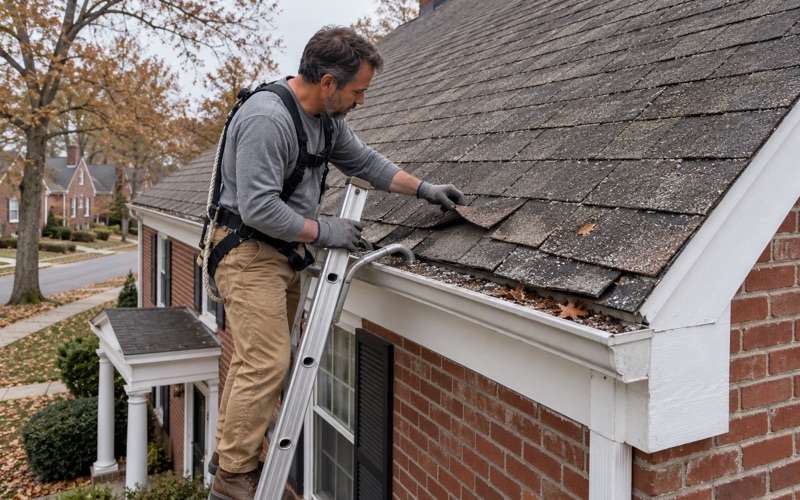
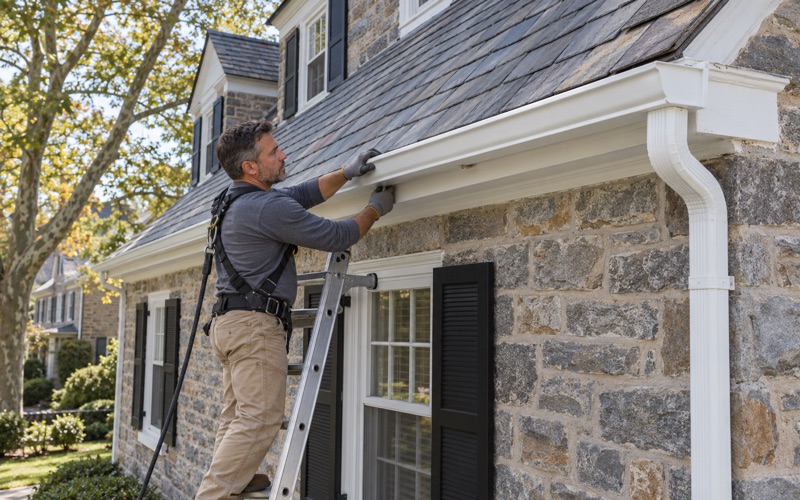
We start at the edges and the chimney, because that is where the Christmas Eve damage showed up. Then we walk the field of the roof for lifted or creased tabs, check pipe boots and vents, and look at the gutters and downspouts, which tear loose in the same winds and send water against the fascia.
Inside, we check the attic for daylight, wet insulation and staining. If the roof can be repaired, you hear that first, with a written scope that lists flashing, decking, underlayment, ventilation and gutters as separate lines.
Twins and Attached Homes
On a twin or a townhouse the roof does not stop at your property line. Wind damage often runs across the shared ridge, and a repair that ends abruptly at the party wall can leave a seam that leaks into both homes.
We plan attached-home roofs with the neighbor’s roof and the shared wall in mind. Where the neighbor’s side is damaged too, we explain what each owner is looking at so the work can be coordinated rather than done twice.
Photos for Your Own Claim
After a storm we photograph the damage and write it up so you have a clear record for your own insurance claim. If you ask, our crew will meet the adjuster on site to show what we found.
We do not negotiate the claim for you; that is a role Pennsylvania law reserves for licensed public adjusters. Our part is an honest record of what the roof needs and what it will cost to fix it.
Township Paperwork Before Work Starts
West Norriton Township handles construction permits through its building office, with applications reviewed by Code Inspections, and its permit application includes a contractor table with a Roofing row and a question about whether the property sits in a historic district. We have found no township statement on whether a residential re-roof needs a permit, so we check with the building office for each house before the job is priced.
Our contracts follow Pennsylvania’s home improvement law, including the three-business-day cancellation notice and a deposit kept within the legal limit. At the end of each work day we clean the driveway, the yard and the gutters, and we run a magnet sweep for roofing nails.
- 20+ Years Roofing
- Itemized Written Scopes
- Slate Repair Specialists