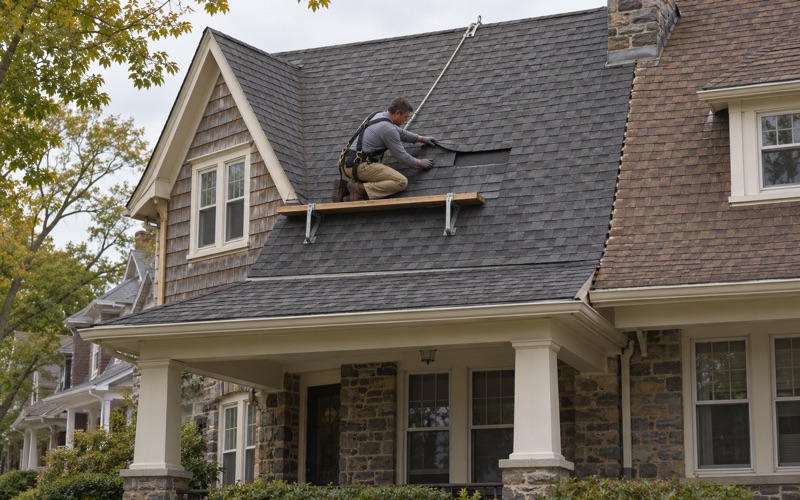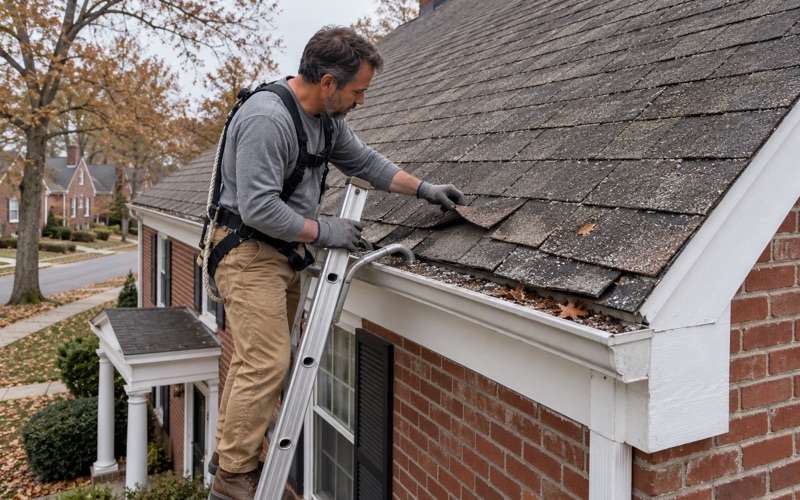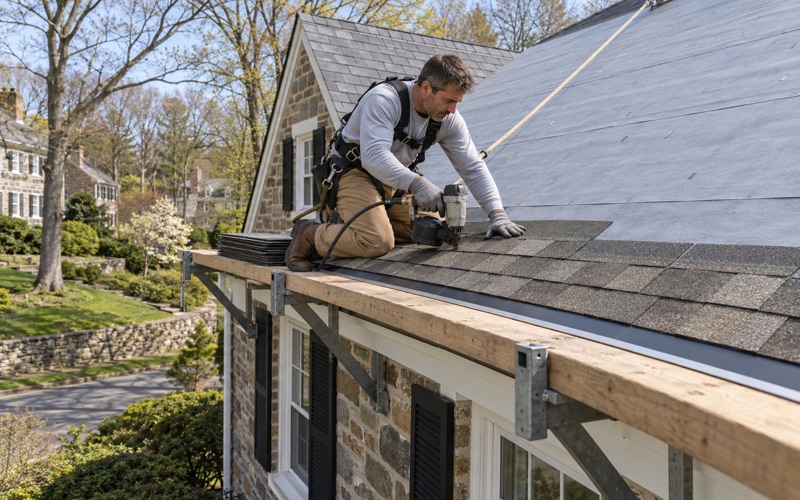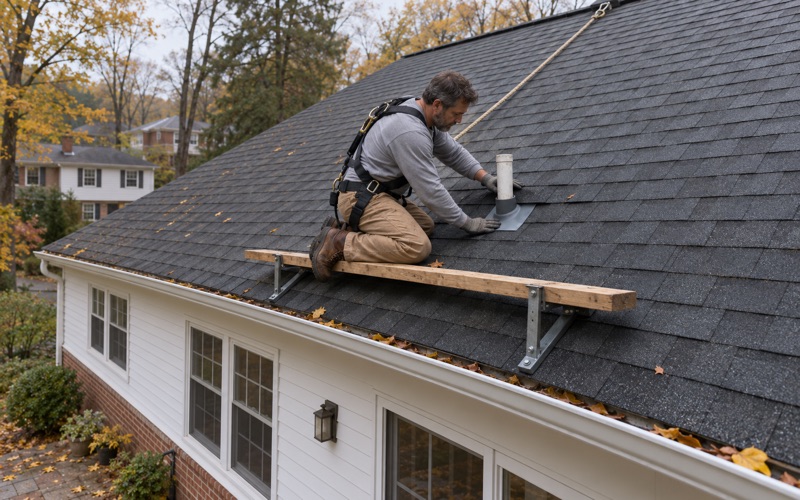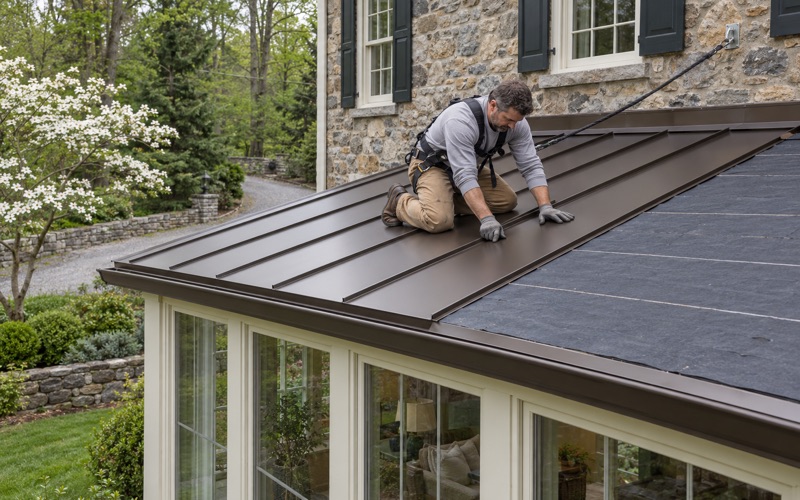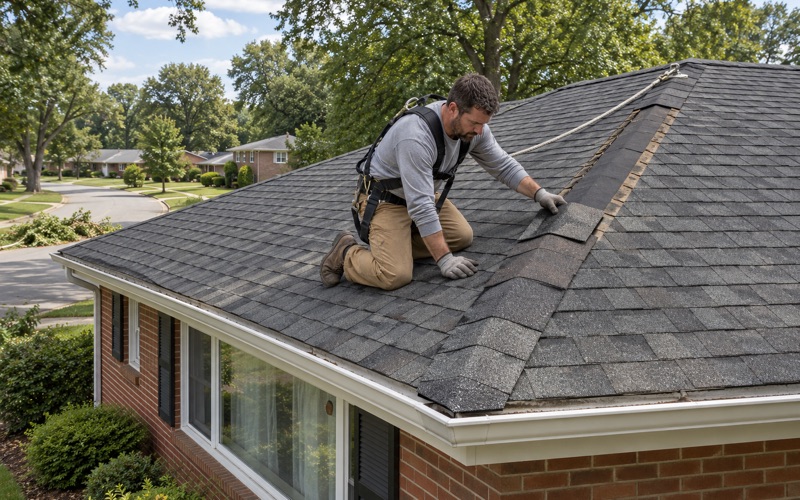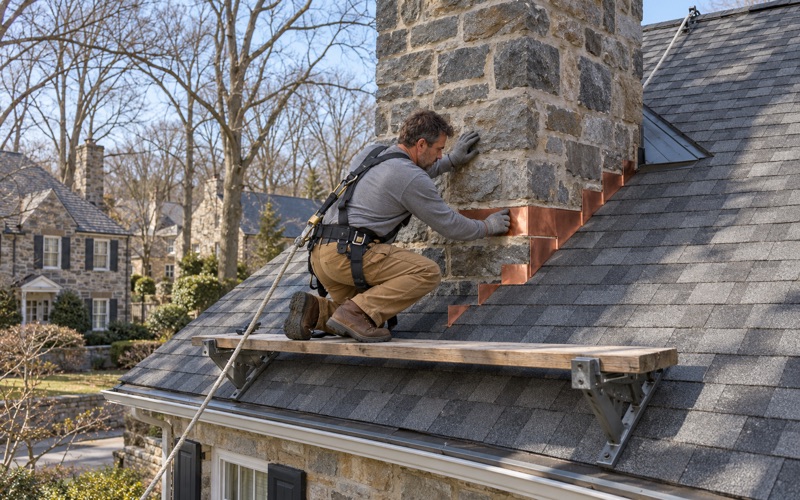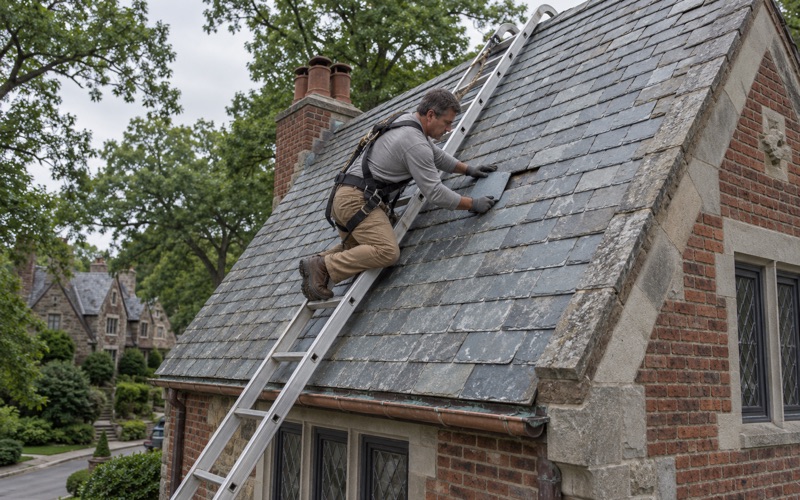
Lower Merion Elite Roofing brings more than 20 years in the trade to roofing in Willistown, and every leak call we answer here starts in two places at once. Someone goes up on the roof and someone goes into the attic, so the water is traced to the spot where it actually gets in before a single number is written down.
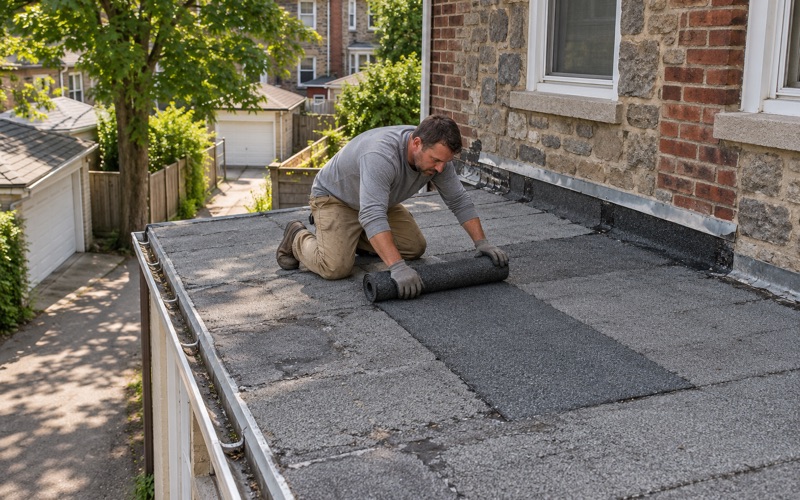
The second thing you get is a straight answer on repair. If the roof has years left in it, we say so and price the fix, and replacement only comes up when repair would be money spent on a roof that is finished. When it is finished, our written scope lists tear-off, decking, underlayment, flashing, ventilation and gutters as separate lines, so any other estimate can be set beside ours and compared item by item.
Permits sit inside that scope from the first visit. Each township in our service area writes its own re-roofing rules, and we check the rule for the township your house is actually in before the job is priced. Here, that check includes a question most roof estimates skip entirely: where the house sits on the township’s flood map.
Willistown’s Township-Wide Floodplain Permit
What the floodplain article says
Willistown’s floodplain article was amended on August 14, 2017, by Ordinance 5-2017, under the Pennsylvania Flood Plain Management Act of 1978, which hands floodplain regulation to local governments. As search summaries of the township code return it, the article makes it unlawful for any person, partnership, business or corporation to undertake any construction or development anywhere within Willistown Township unless a permit has been obtained from the Floodplain Administrator.
The word that stands out is anywhere. On its face, the wording is not limited to a mapped flood zone; the chapter is written township-wide. We have not read how the township applies that wording to ordinary roof repair, so we will not tell you whether your job needs a floodplain permit. We will tell you who decides, and we ask before a crew is scheduled.
Who the Floodplain Administrator is
The Floodplain Administrator is the township official who issues that permit, and Willistown Township’s offices at 688 Sugartown Road in Malvern are where permit questions begin. The building permit office takes applications by email at permits@willistown.pa.us, and the township’s building permit page says all building permits require a zoning permit as well.
For a small repair far from any stream, that conversation may be short. For a full replacement on a house near a creek, it can set the order of the whole project, which is why we would rather have the answer before materials are ordered than after shingles are stacked on the driveway.
Mailing address versus township
Parts of Willistown carry Malvern and Paoli mailing addresses, and Malvern Borough itself was set off from the township in 1889. A Malvern address does not tell you which government issues your permits. Before anything else, we confirm that the house is in Willistown Township, because that decides whose floodplain chapter, zoning permit and building permit apply.
Looking for roofing closer to Worcester? See Worcester Roofing.
The 2017 Flood Maps and the Creeks Behind Them
The September 29, 2017 maps
FEMA’s Community Status Book lists Willistown Township, Chester County, as community 422282C. Its first flood hazard boundary map is dated December 27, 1974, its first flood insurance rate map October 15, 1981, and its current effective map September 29, 2017. Those 2017 maps are the ones that apply to a house today.
Before a large roof job on a house anywhere near water, we look the address up on those maps with you. Two houses on the same road can land on different sides of a mapped line, and the map, not the view from the back porch, is what the township reads when it decides what a project needs.
No Community Rating System discount
The same FEMA listing shows no Community Rating System class for Willistown. The Community Rating System is FEMA’s program that lowers flood insurance premiums where a community goes beyond the minimum floodplain rules, and Willistown takes part in none of it, so a flood policy here carries no township-level discount.
That has a practical edge for a roof project. If your house carries flood insurance because of where it sits, it is exactly the house where a call to the township before a big job is worth making, and the house where a surprise in the permit process costs the most.
Crum, Ridley and Darby: where the water goes
Willistown’s land drains toward three streams: the Crum Creek, the Ridley Creek and the Darby Creek. The township is one of seventeen municipalities in the Crum Creek watershed, four of them in Chester County. Willistown sits upstream on the Crum and Ridley, and the towns downstream along those creeks keep their own maps and their own permit rules.
That last point matters more than it sounds. A neighbor’s roofing experience in another township on the same creek says nothing about what Willistown requires. Each municipality writes its own chapter, and the creek a house drains toward is a reason to check the map, never a substitute for checking it.
Gutters sized for the water they carry
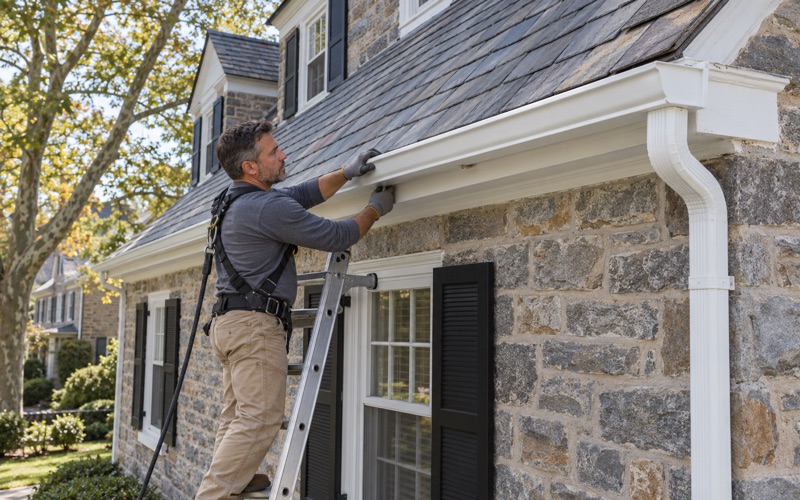
Gutters and downspouts are sized and pitched with the roof, not treated as an add-on at the end. On a house near one of those creeks, where each downspout empties is part of the design, so water shed from the roof is carried away from the foundation instead of being dumped at a corner.
Seamless aluminum gutters suit most of the houses we see, and half-round copper suits a slate roof. Kick-out flashing where a roof edge meets a sidewall keeps runoff in the gutter rather than behind the siding, and a properly sized downspout keeps a heavy storm from overrunning the system.
Roof Work and the 50 Percent Substantial-Improvement Test
What federal rules call a substantial improvement
Under federal floodplain rules in 44 CFR 59.1, work on a floodplain building that costs 50 percent or more of its market value is a substantial improvement. Crossing that line changes what the project as a whole has to meet, which is why it is worth knowing about before a contract is signed rather than after.
The Census Bureau’s 2024 five-year estimates put Willistown’s median home value at $617,800. That figure describes the whole township, not any one house, and it is a home value, not the structure value the federal test looks at, so it cannot tell you where your own line falls.
What we have not read, and will not guess
We have not read whether Willistown counts a re-roof toward that 50 percent test, or whether it sets aside minor repairs. So we will not promise that a replacement falls safely under the line, and we will not warn that it is caught by it.
That question belongs to the Floodplain Administrator. What we bring is a written scope with each cost on its own line, which is the kind of document an official needs in hand to give an answer.
When several projects land in one year
A roof replacement often travels with other work. New gutters, decking that turned out to be soft, a solar array that has to come off and go back on, or an interior renovation in the same season can make a project larger than the roof alone. On a house near the Crum, Ridley or Darby, we suggest knowing the total of the whole season’s planned work before the call to the township.
Decking is the cost nobody can see in advance. When the old roof comes off and boards have failed, we photograph them and show you before replacing anything, at the per-sheet price written into the contract, so the total never changes without your knowing why.
Planning a Large Roof Job in Willistown
The order we follow
First the flood map, then the Floodplain Administrator if the house is near a creek, then the zoning and building permits. The township’s application for a building permit lists repair and replacement as a type of improvement, and every owner named on the deed has to sign it, so a house held in two names needs both signatures before it can be filed.
Solar panels go into the schedule at this stage too. If an array has to come off for the roof, the removal and reinstall are booked as part of the plan rather than discovered on the morning the crew arrives.
Attached homes and shared walls
The Census Bureau’s 2024 estimates count 1,196 single-family attached units in Willistown, 26.2 percent of the housing, and 92.9 percent of occupied homes are owner-occupied. On a twin or attached house, we plan the roof with the neighbor’s roof and the shared wall in mind, because the flashing and drainage at that wall serve two homes at once.
That usually means a conversation with the neighbor before work starts. Where the two roofs meet, the detail has to tie into a roof we are not replacing, and it has to keep shedding water toward the gutters on both sides.
Storms, flashing and paperwork
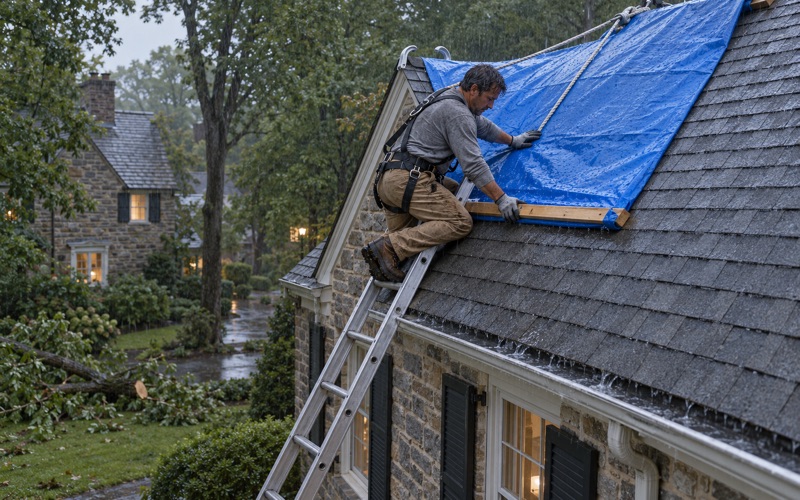
Willistown falls in the National Weather Service’s Eastern Chester forecast zone, served from the Mount Holly office, and that is the forecast we watch before opening a roof for tear-off. When a storm does cause damage, we photograph it and write it up for your own claim, and we will meet your insurance adjuster on site if you ask, without negotiating the claim for you.
Step, counter and chimney flashing are replaced with the roof rather than reused under new material. Contracts follow Pennsylvania’s home improvement law, with the three-business-day cancellation notice and a deposit kept within the legal limit, and at the end of every work day the driveway, yard and gutters are cleaned, including a magnet sweep for roofing nails.
- 20+ Years Roofing
- Itemized Written Scopes
- Slate Repair Specialists