Lower Merion Elite Roofing has spent more than 20 years on roofing in Yeadon and across the Main Line, and the houses here raise a question that most roof estimates skip. Before anyone prices a tear-off, it helps to know whether the painted boards along the roof edge are already part of a county lead-paint project. Settling that first can save an owner from paying to disturb the same trim twice.
We start every job the same way, whether the call is a leak, a worn-out shingle roof or a storm repair. On a leak we go into the attic as well as onto the roof, so the water is traced to where it actually enters before a number is written down. Then we tell you plainly whether the roof can be repaired, and only after that do we talk about replacement.
When replacement is the right answer, our written scope breaks the work into separate lines for tear-off, decking, underlayment, flashing, ventilation and gutters. That lets you set our estimate beside anyone else’s and compare it item by item. On an older house, it also shows exactly where the roof job ends and where painted trim work would begin.
Yeadon and Delaware County’s Lead Program
Yeadon is a borough in Delaware County that borders the city of Philadelphia, and the county counts it among the places where lead paint in older housing is a priority. Delaware County runs a Lead Hazard Reduction Program through its Health Department and its Office of Housing and Community Development. The program is funded by a grant from HUD’s Office of Lead Hazard Control and Healthy Homes.
Target Area B and why it matters here
The county Planning Department’s map places Yeadon Borough in Target Area B, one of the areas the program singles out. Applications are handled first come, first served, with priority going to households whose children have tested positive for elevated blood lead and to households inside a target area. For a Yeadon family, the address itself helps move an application up the line.
That priority does not mean funding is guaranteed. The program works within the limits of its grant, and the income figures it uses are reset over time. Anyone considering it should check the current guidebook and apply early rather than assume a slot will be open when the roof is due.
The age of the housing stock
Yeadon’s homes are old enough that the program’s age test is rarely the obstacle. Census estimates count 4,913 of the borough’s 5,573 housing units, or 88.2 percent, as built in 1979 or earlier. The Census buckets do not split at 1978, so the exact pre-1978 share is a little lower and is not published.
Of those same units, 3,619 predate 1960. A house of that age has usually been painted many times along its fascia, soffit and rake boards, and nobody can say what is in those layers without a test. We never assume a particular Yeadon house carries lead, and we never treat one as clear without the county’s answer.
Looking for roofing closer to Richland Township? See Roofing in Richland Township.
Who Qualifies and What the County’s Contractors Do
The guidebook sets out a short list of conditions, and a household has to meet all of them. Because the program is about children’s exposure, the household test matters as much as the building test. Here is how the rules read in the 2026 edition.
Homes built before 1978 with children under 6
The home or property must have been built before 1978. The household must have children under 6 living there, or a child who spends more than 6 hours a week or 60 hours a year in the home, or the family must be expecting a child. Owners must also carry homeowner’s insurance and be current on real estate, school and municipal taxes.
Income limits took effect on June 1, 2025 and run from $68,750 for one person to $113,900 for a household of six. An owner applying for their own home must live there as a primary residence and own no other property. Landlords can apply, and renters can too with the landlord’s consent, which matters in a borough where more than half of occupied homes are rented.
What the remediation covers
Eligible work is limited to identifying and removing lead-based paint hazards. A certified lead inspection and risk assessment covers both interior and exterior surfaces, and that assessment sets the scope of work. The guidebook names window and door replacement, vinyl wrapping, replacing trim and moldings, and scraping and sealing loose or deteriorated paint as typical remedies.
The work itself goes to certified lead abatement contractors on a pre-approved list the county and its assessment consultant keep. Those contractors bid the job, pull any municipal permits, and start within 10 days of the notice to proceed, with 10 days to finish. Households may relocate for up to 10 days while the work is done.
What the program does not pay for
Roofing is not on the list of eligible work, and neither are gutters. The county program will not replace a worn roof, and no one should plan a re-roof expecting it to. We are not one of the county’s lead contractors, and the inspection belongs to the county’s certified consultant rather than to a roofer.
The guidebook also leaves one question open that matters to anyone with an old roof. It does not say whether fascia, soffit or rake boards count as trim. Only the county’s assessment and scope of work can answer that for a particular house.
Where Lead Work and a Roof Job Meet: The Painted Roof Edge
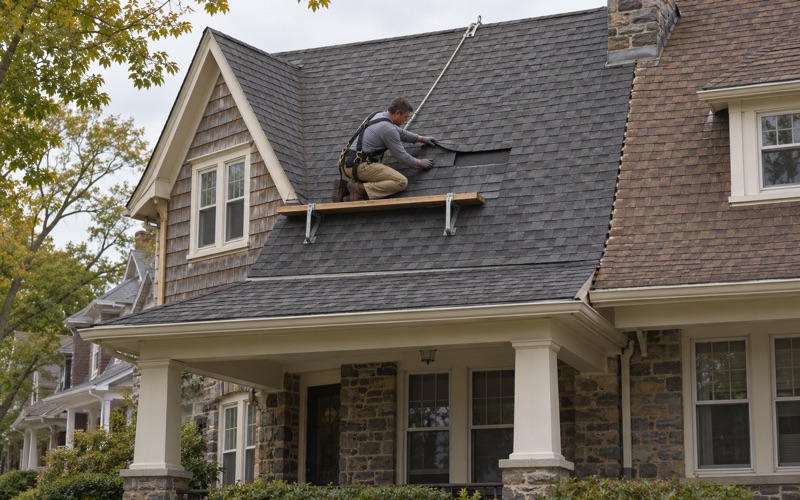
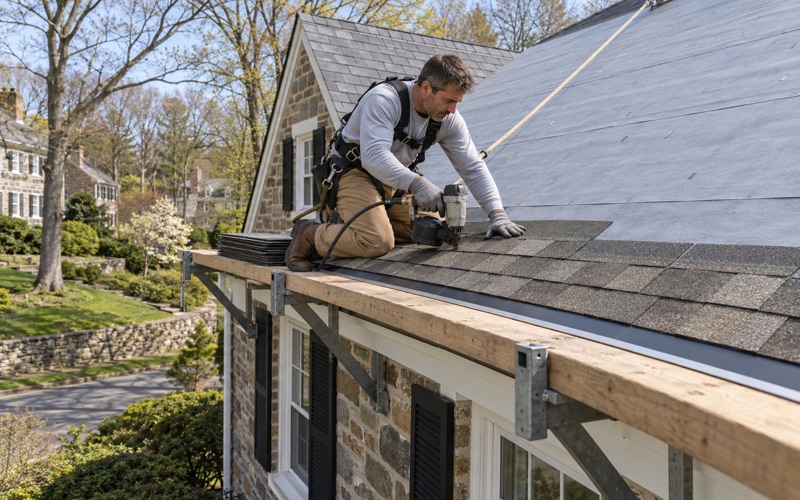
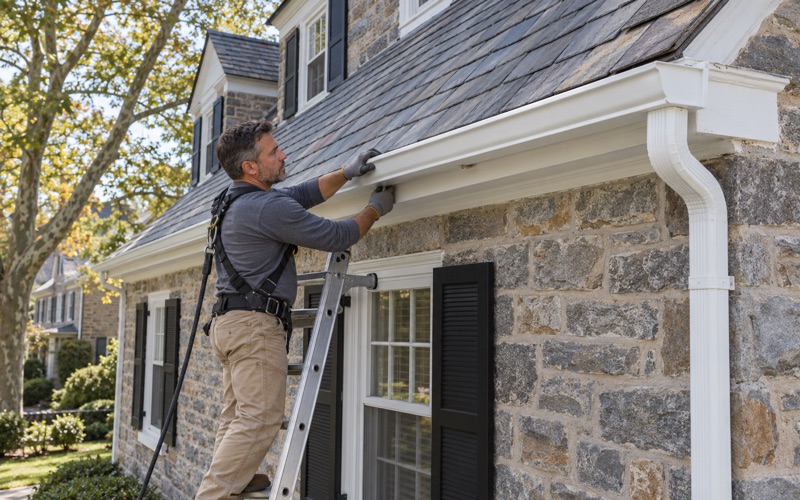
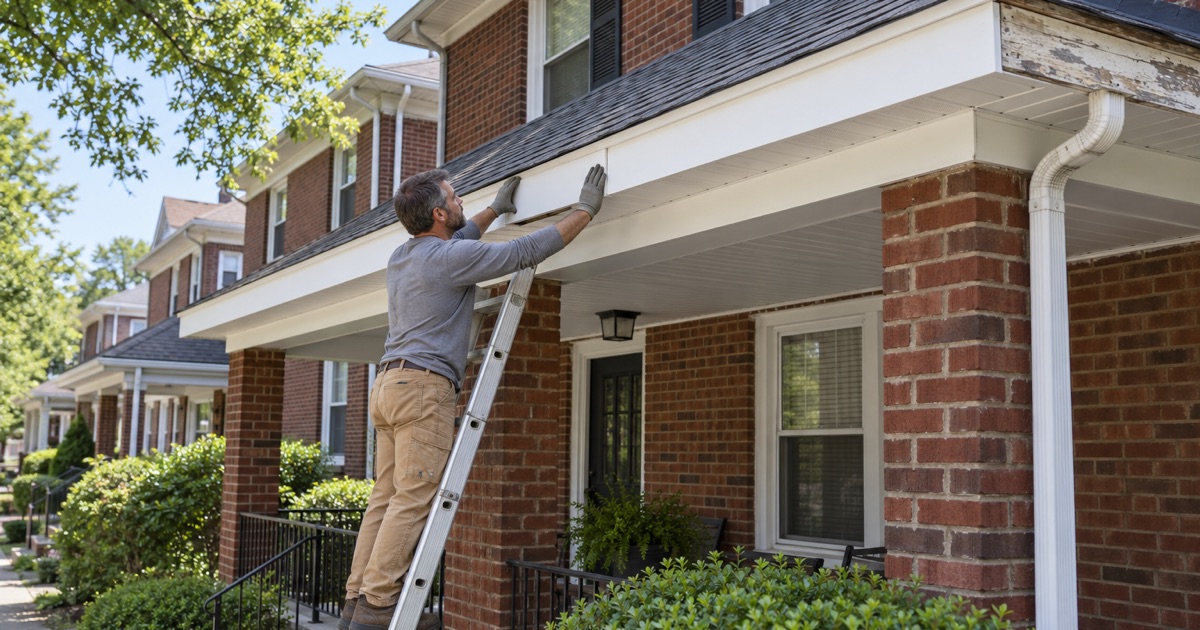
A roof does not end at the shingles. Along the eaves and up the gables, painted wood boards close off the rafter ends, hold the gutters and carry the drip edge. On an older Yeadon house, those boards are the one place where a roofing crew and a lead scope could end up working on the same surface.
Fascia, soffit and rake boards
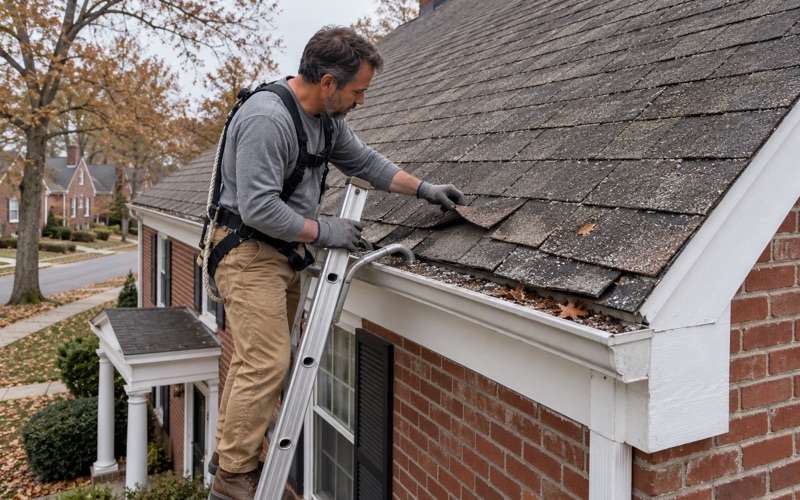
The fascia is the board the gutters hang from, the soffit closes the underside of the overhang, and the rake boards trim the sloped edges of the gables. Each may carry decades of paint. A re-roof often disturbs them when old drip edge comes off, when rotten fascia is replaced, or when gutters are rehung.
If the county’s assessment finds a hazard on those boards and its contractor wraps or replaces them, that work should happen in the right order around the roof. Wrapping fascia in vinyl and then pulling it apart weeks later for new drip edge and gutters wastes both jobs. Whether the edge falls inside the county’s scope stays an open question until the assessment says so.
How we treat painted trim on older houses
Where painted trim on a pre-1978 home will be disturbed, the federal EPA lead-safe rule for renovation applies to that work, and we plan for it in the scope. That rule runs alongside the county program and is no substitute for it. A lead-safe practice during a roof job does not test the paint and does not remove a hazard the way the county’s work is meant to.
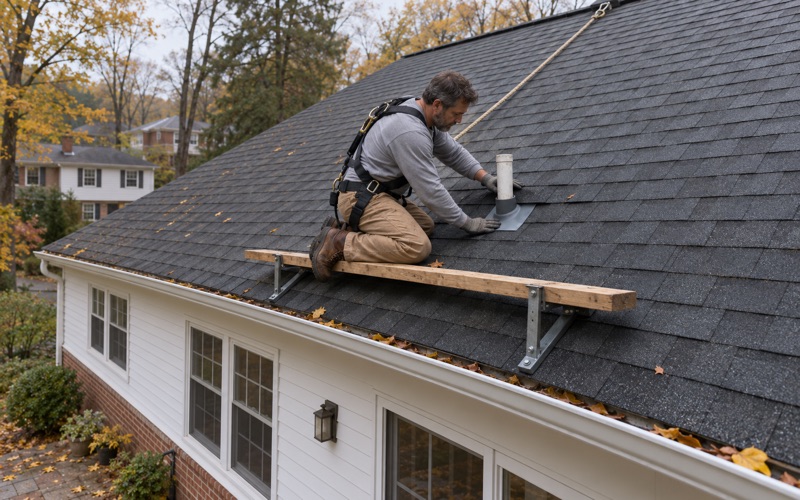
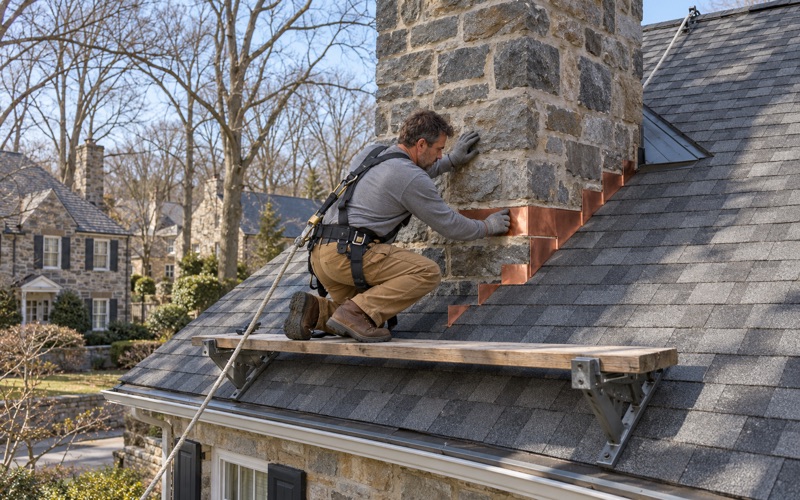
We also replace step, counter and chimney flashing with the roof rather than reusing it under new material. Where flashing meets painted wood at a chimney or a dormer, we note the condition of that wood in the written scope so you can see it before any decision is made.
Gutters belong to the same edge
Gutters and downspouts hang on the fascia, so we size and pitch them with the roof instead of treating them as an afterthought. If the county’s contractor is going to replace or wrap fascia, new gutters should go up after that work, not before. Hanging new gutters on a board that is about to be removed only means paying to hang them twice.
Planning a Re-Roof Around a Lead Inspection
The sequence is simple once the questions are in the right order. Find out whether your household may qualify, learn what the county’s assessment includes, and then price the roof around it. Our job is to make the roof scope fit whatever the county decides rather than get in its way.
Settle the lead question before the roof is priced
If a child under 6 lives at home or one is on the way, and your income falls within the limits, contact the county program before signing a roof contract. Ask whether the assessment will look at exterior trim at the roof edge. Once you know what the county’s scope covers, we can write a roof estimate that leaves that work to its contractor and covers everything else.
If you do not qualify or choose not to apply, we still write the scope with the painted edge on its own lines. That way the trim work is visible, priced separately, and easy to compare against another estimate.
What a sequenced job looks like
When the county’s work is going ahead, the usual order is lead work first, then the roof, then the gutters. If the roof is leaking badly in the meantime, a targeted repair can hold it until the lead scope is done, and we will tell you honestly whether a repair is enough. Decking we find damaged once the old roof is off is photographed and shown to you before it is replaced, at a per-sheet price set in the contract.
Each day ends with the driveway, yard and gutters cleaned and a magnet sweep for roofing nails. On a house where children are part of the reason for the lead work in the first place, that cleanup is not a courtesy. It is part of keeping the property safe while the job is open.
Checking the borough’s own requirements
Every borough and township in the area sets its own rule for re-roofing, so we check Yeadon’s before the job is priced rather than after. The county’s lead contractors pull their own municipal permits for their part of the work. We handle the roof side, and we keep the two scopes separate so neither one holds up the other.
- 20+ Years Roofing
- Itemized Written Scopes
- Slate Repair Specialists